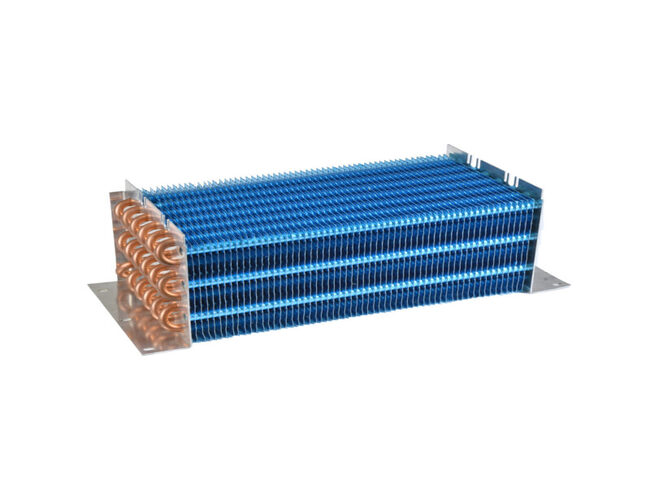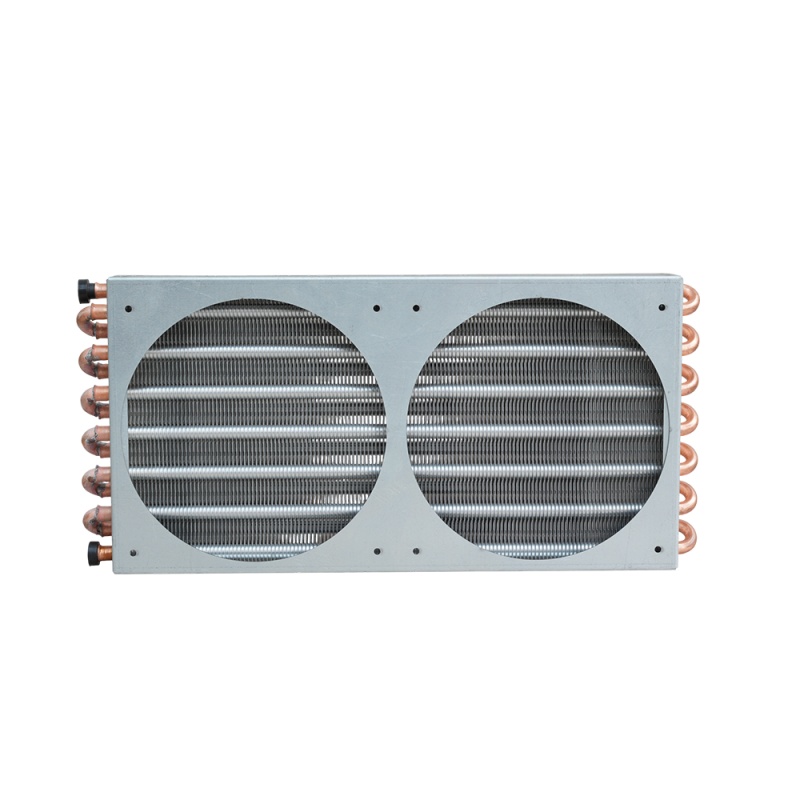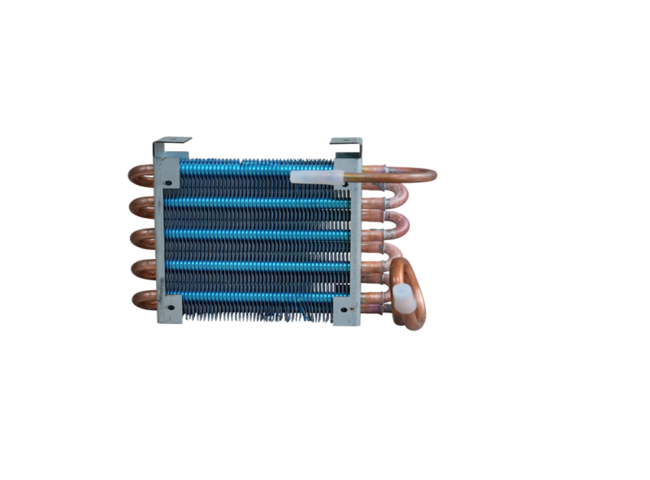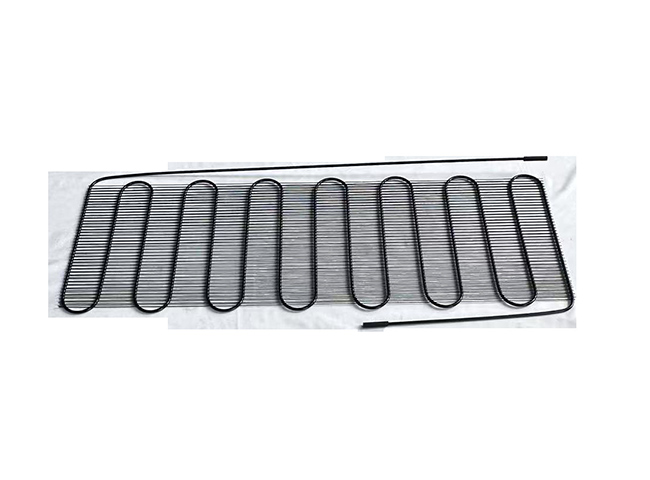
Choosing between an air-cooled condenser and a water-cooled condenser is not simply a decision about whether to use air or water to remove heat. For refrigeration OEMs, system integrators, equipment manufacturers, and industrial buyers, the choice affects condensing temperature, compressor power, installation requirements, maintenance workload, operating costs, and long-term system reliability.
An air-cooled condenser rejects refrigerant heat directly to ambient air, usually with a finned-tube coil and fans. A water-cooled condenser transfers refrigerant heat to circulating water, which must then reject that heat through a cooling tower, another heat-rejection device, or an appropriate once-through water arrangement.
Both configurations can perform well when properly selected. However, their suitability changes with outdoor temperature, water availability, required cooling capacity, operating hours, site restrictions, and the cost of utilities.
The key selection principle is to compare the complete refrigeration system under the same operating conditions—not just the condenser’s purchase price or heat-transfer rating.
This guide explains the engineering differences between air-cooled and water-cooled condensers, compares efficiency and lifecycle costs, and provides a practical checklist for selecting a condenser for commercial refrigeration, industrial cooling, and OEM applications.
Air-Cooled vs. Water-Cooled Condenser: Key Differences at a Glance
Comparison Table: Air-Cooled Condenser vs. Water-Cooled Condenser
| Selection factor | Condenseur à refroidissement par air | Condenseur à refroidissement par eau |
|---|---|---|
| Fluide caloporteur | Air ambiant | Circulating water |
| Typical heat-rejection arrangement | Refrigerant coil, fins, fans, and airflow path | Refrigerant-to-water heat exchanger and water circuit |
| Additional heat-rejection equipment | Usually no separate cooling tower | Often requires a cooling tower or another method of rejecting heat from the water |
| Installation complexity | Generally simpler | Generally more complex |
| Water consumption | No condenser cooling water required | May consume water if a cooling tower or evaporative heat-rejection arrangement is used |
| Condenser-side electrical loads | Primarily fan motors | Water pumps and, where applicable, cooling-tower fans and auxiliaries |
| Sensitivity to outdoor conditions | Strongly affected by entering-air dry-bulb temperature and airflow | Strongly affected by cooling-water temperature, water quality, and heat-rejection conditions |
| Condensing temperature potential | Limited by ambient-air conditions and required heat-transfer approach | Can be lower when favorable cooling-water temperatures are available |
| Traitement de l'eau | Not required for the condenser’s air side | Usually required for recirculating cooling-water systems |
| Routine maintenance | Coil cleaning, fin inspection, fan and motor checks | Water-side cleaning, water treatment, pump checks, and cooling-tower maintenance where applicable |
| Space and access | Requires adequate air circulation and service clearance | Requires space for the condenser, piping, pumps, and potentially a cooling tower |
| Common selection advantage | Simplicity and independence from a cooling-water system | Potential for lower condensing temperatures and improved whole-system efficiency in suitable applications |
| Main selection concern | High ambient temperatures, recirculated hot air, and coil fouling | Water availability, water quality, treatment costs, and additional equipment |
These are general comparisons, not guarantees for every installation. Actual performance depends on the refrigerant, heat-rejection duty, equipment design, entering-air or entering-water conditions, fouling allowance, and operating schedule.

The Most Important Difference: Cooling Medium and System Configuration
An air-cooled condenser transfers heat from the refrigerant to air. The air then carries the heat away from the equipment and releases it into the surrounding environment.
A water-cooled condenser transfers heat from the refrigerant into water. That water must subsequently reject the absorbed heat. In a common recirculating arrangement, a cooling tower cools the water before it returns to the condenser.
This distinction affects the entire system.
An air-cooled design usually requires fewer supporting components. A water-cooled design introduces a water circuit, pumps, piping, and potentially a cooling tower, water-treatment equipment, and associated controls.
However, additional components do not automatically make a water-cooled system a poor choice. In a large installation with long operating hours, favorable wet-bulb conditions, and an effective water-management program, the energy savings associated with lower condensing temperatures may justify the added complexity.
The correct comparison therefore includes:
- Condenser heat-transfer performance.
- Compressor power at the actual operating conditions.
- Fan, pump, and cooling-tower power.
- Water consumption and treatment.
- Installation and maintenance costs.
- Reliability requirements and the consequences of downtime.
Which Option Is Better for Your Application?
An air-cooled condenser is often the practical starting point when a project needs a relatively simple installation, has limited access to water, or cannot support the maintenance requirements of a cooling-water system.
A water-cooled condenser deserves closer evaluation when the installation has a substantial, continuous heat-rejection load, favorable cooling-water conditions, and the resources to maintain water quality and supporting equipment.
| If your project has this condition | Initial direction for evaluation |
|---|---|
| Water is scarce, expensive, or unavailable | Air-cooled |
| The site has limited space for piping and auxiliary equipment | Often air-cooled, subject to airflow and clearance requirements |
| Outdoor temperatures are high for extended periods | Compare both options using design-condition calculations |
| The refrigeration system runs for many hours each year | Conduct a whole-system lifecycle cost comparison |
| Stable cooling-water conditions and suitable water treatment are available | Evaluate water-cooled |
| Maintenance staff cannot support water treatment and cooling-tower upkeep | Often air-cooled |
| The equipment operates in a dusty or corrosive outdoor environment | Evaluate coil protection, cleaning access, and material compatibility; neither option is automatically superior |
| The system has strict energy targets | Compare compressor, fan, pump, and cooling-tower energy at full and part load |
The table is a screening tool, not a substitute for engineering selection.
What Is an Air-Cooled Condenser?
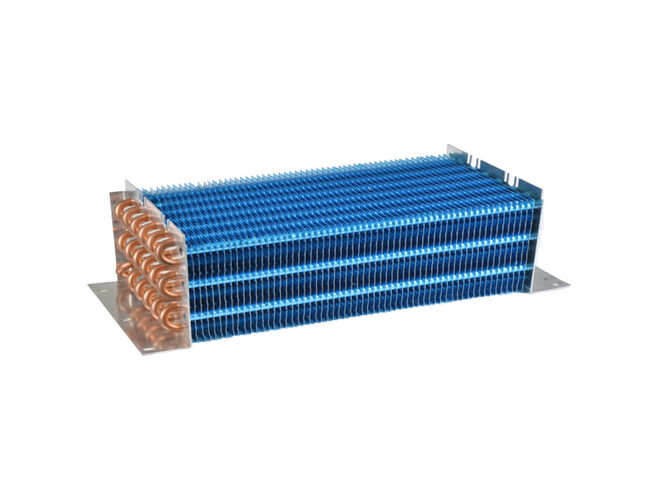
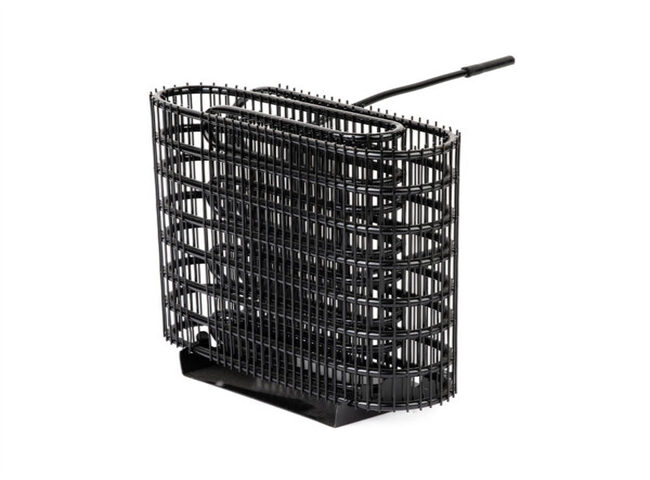
An air-cooled condenser is a heat exchanger that removes heat from hot refrigerant vapor by transferring it to ambient air. It is widely used in refrigeration equipment where a dedicated cooling-water circuit is unnecessary or impractical.
The condenser is part of the vapor-compression refrigeration cycle. After the compressor raises the refrigerant vapor’s pressure and temperature, the condenser rejects heat so the refrigerant can become liquid and continue toward the expansion device and evaporator.
Air-Cooled Condenser Working Principle
A typical forced-air condenser operates in the following sequence:
- The compressor delivers hot, high-pressure refrigerant vapor to the condenser.
- The refrigerant enters the coil and transfers heat through the tube wall to the surrounding fins.
- Fans move ambient air across the finned coil, carrying heat away from the refrigerant.
- The refrigerant first loses superheat, then condenses from vapor to liquid.
- If the design and operating conditions permit, the liquid refrigerant may be further cooled below its saturation temperature, producing subcooling.
- The liquid refrigerant leaves the condenser and continues through the refrigeration circuit.
The three heat-transfer stages are desuperheating, condensation, and subcooling. These heat-transfer stages are part of the broader condenser design process. For a more detailed explanation of condenser configurations, heat-transfer principles, sizing considerations, and selection factors, see our guide to refrigeration condenser types and selection. Their relative sizes vary with refrigerant, entering conditions, coil design, and operating point. The condensation stage commonly accounts for the largest share of heat rejection in conventional applications.
Engineering consideration: A condenser must be selected for its required heat-rejection capacity, not merely the evaporator’s cooling capacity.
The condenser must reject both the heat absorbed in the evaporator and the heat added by the compressor, subject to the system configuration. Understanding the function of a condenser in a refrigeration system helps explain why the required heat-rejection capacity is not necessarily equal to the evaporator’s rated cooling capacity.
The condenser rejects the evaporator load plus the heat added by the compressor, subject to the system configuration and any independent heat-rejection paths. Therefore, a condenser rated only by a nominal cooling-capacity figure may be incorrectly sized if the rating basis is not understood.
The condenser is only one stage of the vapor-compression cycle. Its performance is closely connected to the compressor, expansion device, and evaporator, so condenser selection should be evaluated within the operating conditions of the complete system. Read our guide to le fonctionnement du cycle de réfrigération for a step-by-step explanation of these component interactions.
Principaux composants d'un condenseur à refroidissement par air
Refrigerant Coil, Tubes, and Fins
The coil contains the refrigerant passages. Heat travels from the refrigerant through the tube wall and into the external fins, which increase the surface area available for heat transfer to air.
Important design variables include:
- Tube material, outside diameter, wall thickness, and circuit arrangement.
- Fin material, thickness, spacing, and geometry.
- Number of tube rows and total heat-transfer surface.
- Refrigerant distribution and circuit pressure drop.
- Coil face area and air-side pressure drop.
- Corrosion resistance and cleaning accessibility.
More surface area does not always mean better overall performance. Additional rows or denser fins may increase heat-transfer area but can also raise air-side resistance, reduce airflow for a given fan, increase material cost, or make the coil more vulnerable to blockage in dirty environments.
The design must balance heat transfer, refrigerant pressure drop, airflow, size, cost, and maintainability.
Fans, Motors, and Airflow Arrangement
Fans force or induce air movement through the coil. Their selection influences heat-transfer performance, electrical consumption, sound level, and operating reliability.
A coil can have adequate theoretical heat-transfer area yet perform poorly if the installation restricts airflow. Common problems include:
- Insufficient clearance around the air inlet or discharge.
- Hot discharge air recirculating into the condenser.
- Dust, leaves, grease, or fibers blocking the fins.
- Incorrect fan rotation or control settings.
- Fan operation outside the intended operating range.
Airflow should therefore be evaluated in the installed configuration, not only on a component drawing.
Refrigerant Connections and Condenser Controls
Refrigerant inlet and outlet connections must suit the system’s refrigerant, pressure requirements, pipework, and connection standards.
Controls may include fan staging, variable-speed fan control, pressure-based regulation, and other measures used to maintain appropriate operating conditions.
The exact control strategy depends on the refrigeration system. In low-ambient operation, for example, the condenser may need controls to prevent condensing pressure from falling below the level required by the expansion device or system design.
A condenser selection request should identify the refrigerant, design operating pressures, expected ambient range, and control requirements rather than specifying only the external dimensions.
Types of Air-Cooled Condensers
Air-cooled condensers can be classified in several ways. These categories overlap; they should not be treated as mutually exclusive types.
| Classification | Common configurations | Selection considerations |
|---|---|---|
| Airflow method | Forced draft, induced draft | Fan location, airflow distribution, temperature exposure, service access |
| Coil arrangement | Horizontal, vertical, angled, A-frame | Available footprint, airflow path, structural support, access |
| Equipment arrangement | Remote condenser, integral or packaged condensing unit | Installation layout, refrigerant piping, service requirements |
| Coil construction | Finned-tube, microchannel where suitable | Refrigerant compatibility, pressure rating, corrosion exposure, cleaning and repair requirements |
| Disposition des ventilateurs | Single fan, multiple fans, staged or variable speed | Capacity control, redundancy, noise, part-load efficiency |
A forced-draft air-cooled condenser generally uses fans to push air through the coil. An induced-draft arrangement draws air through the coil. The best configuration depends on the equipment geometry, airflow distribution, ambient conditions, noise requirements, and maintenance access.
A-frame coils may provide substantial heat-transfer area in a compact footprint, while flat or vertical coil arrangements may be suitable for different equipment layouts.
The phrase air-cooled condensing unit often refers to a packaged assembly that includes a compressor and an air-cooled condenser. It should not be confused with a remote air-cooled condenser supplied as a separate component.
Fin Materials in Air-Cooled Condensers
Fin material affects heat transfer, weight, corrosion resistance, manufacturing cost, and compatibility with the installation environment.
| Material or construction | Potential benefits | Important considerations |
|---|---|---|
| Ailettes en aluminium | Low weight and good thermal conductivity | Corrosion exposure, fin damage, and compatibility with tube and coating systems |
| Copper fins | Good thermal conductivity and material compatibility in selected constructions | Higher material cost and weight considerations |
| Coated fins | May improve resistance to selected corrosive environments | Coating type, coverage, durability, cleaning procedures, and actual exposure conditions |
The material choice should reflect the environment rather than a general assumption that one material is always best.
For coastal locations, chemical-processing facilities, food-processing environments, or sites exposed to corrosive contaminants, buyers should disclose the actual exposure. The manufacturer can then evaluate tube and fin materials, protective coatings, dissimilar-metal interactions, and the expected maintenance method.
A coating should not be treated as a universal guarantee against corrosion. Its effectiveness depends on the coating system, application quality, damaged areas, operating conditions, and maintenance.
Copper Tubing and Internally Enhanced Tubes
Copper tubing is commonly used in finned-tube heat exchangers because it provides favorable thermal conductivity and established manufacturing practices.
Internally enhanced tubes use features such as grooves or other surface geometries to improve refrigerant-side heat transfer under appropriate conditions. The benefit depends on the refrigerant, mass flow, phase distribution, operating pressure, and circuit design.
An enhanced tube is not automatically the best option for every condenser. The design must account for both heat transfer and pressure drop, as well as manufacturing constraints and cleaning or service requirements.
When comparing quotations, buyers should ask whether the quoted performance is based on the actual tube geometry and operating conditions, or whether the comparison is based only on nominal surface area.
Advantages and Limitations of Air-Cooled Condensers
Main Advantages
- Simpler infrastructure: A separate condenser-water circuit is usually unnecessary.
- No routine condenser cooling-water consumption: This can be important where water is restricted or expensive.
- Straightforward installation: The design often avoids cooling-water pumps, water piping, and cooling-tower installation.
- Accessible maintenance tasks: Coil inspection, fin cleaning, and fan checks are familiar service activities.
- Flexible equipment placement: Remote units can be located outdoors when refrigerant piping, structural support, and airflow requirements permit.
Main Limitations
- Ambient-temperature sensitivity: High entering-air temperatures generally increase the condensing temperature required to reject a given heat load.
- Airflow dependence: Blocked fins, fan failure, or hot-air recirculation can reduce capacity.
- Potential noise concerns: Fans may require acoustic consideration in sensitive locations.
- Outdoor exposure: Coils may be exposed to dust, salt, rain, and other contaminants.
- Space requirements: The equipment needs sufficient airflow clearance and service access.
An air-cooled condenser is often attractive because of its simplicity. Its suitability still depends on the design ambient temperature and the ability to maintain the intended airflow throughout the equipment’s operating life.
What Is a Water-Cooled Condenser?
A water-cooled condenser transfers heat from refrigerant to water through a heat exchanger. It is used in refrigeration and cooling systems where a suitable cooling-water supply and the associated infrastructure are available.
The condenser itself is only one part of the heat-rejection arrangement. In a typical recirculating system, water leaving the condenser carries heat to a cooling tower, where the heat is rejected to the atmosphere. The cooled water then returns to the condenser.
This arrangement can enable relatively low condensing temperatures under favorable conditions, but its overall performance depends on the condenser, water circuit, cooling tower, controls, and maintenance program.
Water-Cooled Condenser Working Principle
Le processus de base est le suivant :
- Hot, high-pressure refrigerant vapor enters the condenser.
- Cooling water flows through the heat exchanger’s water passages.
- Heat passes from the refrigerant to the water through the separating heat-transfer surface.
- The refrigerant desuperheats and condenses, and it may undergo liquid subcooling depending on the design.
- The warmed water leaves the condenser.
- In a cooling-tower system, the water transfers heat to the atmosphere and returns at a lower temperature.
Unlike an air-cooled condenser, a water-cooled condenser does not eliminate the need to reject heat to the environment. It transfers heat to an intermediate fluid before that heat is released elsewhere.
The distinction matters when estimating energy and operating costs. A lower refrigerant condensing temperature may reduce compressor power, but water pumps, cooling-tower fans, water treatment, and water consumption must also be included in the comparison.
Main Components of a Water-Cooled Condenser System
Refrigerant Side and Water Side
The refrigerant and water flow through separate passages. The heat exchanger wall transfers heat between them without allowing the fluids to mix during normal operation.
The design must account for refrigerant pressure, water pressure, heat-transfer requirements, fluid compatibility, fouling potential, and pressure drop on both sides.
A condenser can be thermally adequate but still unsuitable if its allowable working pressure, connection sizes, materials, or refrigerant compatibility do not match the system.
Condenser Water Pumps, Piping, and Flow Control
Pumps circulate water through the condenser and associated equipment. Piping, valves, strainers, flow controls, and instrumentation influence the hydraulic performance of the system.
Insufficient water flow may reduce heat transfer or cause the equipment to operate outside its intended conditions. Excessive flow can increase pump power and may create unacceptable pressure drop or velocity-related concerns.
The design should specify:
- Required water flow and entering-water temperature.
- Permissible leaving-water temperature.
- Water-side pressure drop.
- Water quality and treatment requirements.
- Minimum and maximum allowable flow.
- Pressure and temperature measurement points.
These parameters are more useful for engineering selection than the phrase “high-efficiency water-cooled condenser” alone.
Cooling Tower and Water-Treatment System
A cooling tower commonly cools condenser water through contact between water and moving air. Some of the water evaporates, removing heat from the remaining water.
A recirculating system may therefore require makeup water, blowdown, filtration or solids management, chemical treatment, and routine inspection.
The water-treatment strategy depends on makeup-water quality, operating conditions, materials, local requirements, and the risk of scale, corrosion, and biological growth. The U.S. Department of Energy’s cooling-tower guidance explains why water quality and cycles of concentration are important to managing water use and system operation.
For example, increasing the cycles of concentration from three to six can reduce cooling-tower makeup water by about 20% and blowdown by about 50% under the conditions described in DOE guidance. These are potential water-management savings, not guaranteed results for every installation. The achievable concentration ratio depends on makeup-water quality and the treatment program.
A water-cooled system should not be selected on the assumption that water is an unlimited or maintenance-free cooling resource.
Types of Water-Cooled Condensers
Shell-and-Tube Condenser
A shell-and-tube condenser contains a bundle of tubes inside a shell. One fluid flows through the tubes while the other flows through the shell, according to the particular design.
This configuration is widely used in suitable commercial and industrial applications because it can be designed for substantial heat-transfer duties and provides established approaches to inspection and service.
Selection considerations include refrigerant pressure, water-side pressure drop, tube material, tube arrangement, fouling potential, cleaning access, and the required heat-rejection capacity.
Shell-and-Coil Condenser
A shell-and-coil condenser uses a coil within a shell. One fluid passes through the coil while the other occupies the surrounding space, depending on the design.
Its suitability depends on the required capacity, operating pressure, flow arrangement, heat-transfer performance, and service requirements. It should not be assumed to be interchangeable with a shell-and-tube unit solely because both are water-cooled.
Tube-in-Tube Condenser
A tube-in-tube condenser uses one fluid passage inside another. Depending on its construction, the fluids may flow in counterflow or another arrangement selected by the designer.
This configuration can be useful for compact systems and selected smaller or specialized applications. The design must still be checked for pressure drop, required flow, heat-transfer duty, fluid compatibility, and cleaning requirements.
Brazed-Plate Condenser, Where Applicable
A brazed-plate heat exchanger consists of thin plates joined to form alternating fluid passages. Its compact construction can provide high heat-transfer area per unit of volume.
However, its suitability depends on the refrigerant and water pressure ratings, temperature limits, water quality, fouling risk, pressure drop, and serviceability. Some constructions are more difficult to mechanically clean than other heat-exchanger types.
A manufacturer should confirm that the specific model is designed and approved for the intended refrigerant, operating pressure, and duty. “Water-cooled” alone is not enough to establish suitability.
Advantages and Limitations of Water-Cooled Condensers
Main Advantages
- Potentially lower condensing temperatures: Favorable cooling-water conditions can allow the refrigeration system to reject heat at a lower condensing temperature.
- Potential compressor-energy savings: Lower condensing pressure can reduce compressor work, depending on the compressor and operating point.
- Reduced dependence on outdoor dry-bulb temperature at the refrigerant heat exchanger: The condenser receives cooling water rather than directly relying on ambient air across its own coil.
- Flexible equipment arrangement: In some projects, the heat exchanger and heat-rejection equipment can be positioned separately to meet layout requirements.
- Suitable options for substantial heat loads: Selected water-cooled designs can serve demanding commercial and industrial applications.
Main Limitations
- More supporting equipment: Pumps, piping, and often a cooling tower add installation and control requirements.
- Water consumption: Evaporative cooling towers consume water through evaporation and may require blowdown.
- Water-treatment requirements: Poorly controlled water quality can lead to scale, corrosion, and biological fouling.
- Additional maintenance: Water-side inspection, treatment, and cleaning are required as appropriate.
- Potential additional failure points: Pump, valve, cooling-tower, or water-treatment problems can affect the refrigeration system.
A water-cooled condenser is most attractive when the whole system can use its thermal advantages and the site can support its water and maintenance requirements.
Air-Cooled vs. Water-Cooled Condenser Efficiency: Which Performs Better?
There is no universal answer to which condenser is more efficient. The result depends on the operating conditions and what the comparison includes.

Understand the Difference Between Condenser Efficiency and System Efficiency
Condenser performance and refrigeration-system efficiency are related, but they are not the same metric.
A condenser may be evaluated by its heat-rejection capacity, approach temperature, heat-transfer performance, and pressure drop. A complete refrigeration system is more commonly assessed using a measure such as coefficient of performance (COP), energy consumption per unit of cooling, or another defined efficiency metric.
The system comparison must include all relevant electrical loads:
- Compressor.
- Condenser fans or condenser-water pumps.
- Cooling-tower fans and auxiliaries, if present.
- Other system pumps and controls that differ between the alternatives.
For a refrigeration system:
COP = Useful refrigeration capacity ÷ Total relevant power input
A higher COP means more useful cooling per unit of power, provided the same system boundary and operating conditions are used.
For an apples-to-apples comparison, use the same cooling duty, refrigerant, evaporating condition, load profile, and ambient design basis. Then calculate or obtain performance for the complete system under each configuration.
How Ambient Dry-Bulb Temperature Affects Air-Cooled Condensers
Air-cooled condenser performance depends strongly on the temperature of the air entering the coil.
As entering-air temperature increases, the condenser generally needs a higher refrigerant condensing temperature to reject the same heat load, unless the system has sufficient additional heat-transfer capacity to compensate.
A higher condensing temperature typically raises compressor pressure ratio and may increase compressor power. It can also affect the operating envelope of the compressor and other refrigeration components.
The impact is particularly important in locations with:
- High summer design temperatures.
- Long periods of hot weather.
- Restricted condenser ventilation.
- Hot-air recirculation around the equipment.
- Dusty environments that cause frequent coil fouling.
When specifying an air-cooled condenser, use the design entering-air temperature rather than an annual average outdoor temperature. Average conditions can substantially understate the thermal demand during peak operation.
How Cooling-Water Temperature and Wet-Bulb Conditions Affect Water-Cooled Systems
A water-cooled condenser is affected by the temperature of the water entering the heat exchanger. In a cooling-tower system, this temperature depends in part on outdoor wet-bulb temperature, cooling-tower design, water flow, tower approach, load, and operating controls.
Wet-bulb temperature reflects the combined effect of air temperature and moisture. It is therefore important when evaluating evaporative cooling towers.
Under favorable conditions, a cooling tower can deliver water cooler than the outdoor dry-bulb temperature. This may allow a water-cooled condenser to operate at a lower condensing temperature than a comparable air-cooled arrangement.
However, that advantage is not automatic. High wet-bulb temperatures, undersized cooling towers, poor water distribution, fouling, insufficient water flow, or poorly controlled equipment can increase entering-water temperature and reduce performance.
The relevant design question is not simply whether the site has a cooling tower. It is whether the complete water-cooled system can maintain the required water temperature at the required heat-rejection load.
What Is the Typical Temperature Difference for an Air-Cooled Condenser?
The temperature difference used to evaluate an air-cooled condenser depends on the rating convention. One common measure is the difference between the saturated refrigerant condensing temperature and the entering-air dry-bulb temperature.
This is often called the condenser temperature difference or temperature over ambient in industry discussions, but terminology is not fully consistent across manufacturers.
For example, if the saturated condensing temperature is 50°C and the entering-air temperature is 35°C:
Temperature difference = 50°C − 35°C = 15 K
This is a mathematical example, not a universal design target or a claim about the performance of a particular condenser.
The required temperature difference varies with the coil design, refrigerant, airflow, heat-rejection duty, fouling allowance, and rating conditions. A smaller temperature difference may require more heat-transfer area, higher airflow, or a different design trade-off.
When comparing quotations, ask for the entering-air temperature, saturated condensing temperature, capacity, fan power, refrigerant, and any stated rating standard. A temperature difference without its operating conditions is not enough to compare two condensers fairly.
What Is Condenser Approach Temperature?
“Approach temperature” describes how closely a system or heat exchanger brings two relevant temperatures together. The exact definition depends on the equipment and convention being used.
Air-Cooled Condenser Temperature Difference
For an air-cooled condenser, the relevant difference is often:
Saturated condensing temperature − entering-air dry-bulb temperature
A lower value can indicate that the condenser is rejecting heat with a smaller temperature lift above ambient under the specified conditions. It does not, by itself, establish better overall system efficiency. Fan power, coil pressure drop, refrigerant conditions, and actual capacity must also be considered.
Water-Cooled Condenser and Cooling-Tower Approach
For a water-cooled condenser, a commonly used condenser approach is:
Saturated refrigerant condensing temperature − leaving condenser-water temperature
The precise definition should be confirmed with the supplier because rating terminology can vary.
Cooling-tower approach is a different measurement:
Cooling-tower leaving-water temperature − entering-air wet-bulb temperature
These two approaches should not be confused. Condenser approach evaluates the relationship between refrigerant condensing temperature and water leaving the condenser. Cooling-tower approach evaluates how closely the tower cools water to the outdoor wet-bulb temperature.
A complete water-cooled design may need both values to assess whether the condenser and tower can achieve the required operating conditions.
Worked Engineering Comparison: Compare the Same Heat-Rejection Duty
Consider a hypothetical refrigeration project requiring a condenser heat-rejection duty of 100 kW at the design condition. This value is an illustrative assumption, not a measured field result or a product rating.
The project team is comparing two alternatives:
- Option A: air-cooled condenser.
- Option B: water-cooled condenser connected to a cooling tower.
The comparison should use the same refrigerant, required heat-rejection duty, operating schedule, and system boundary.
| Paramètre | Option A: Air-cooled | Option B: Water-cooled |
|---|---|---|
| Décharge thermique requise | 100 kW | 100 kW |
| Heat-transfer medium at condenser | Air ambiant | Eau de refroidissement |
| Design entering condition | Specified outdoor dry-bulb temperature | Specified entering-water temperature, derived from the water system design |
| Condenser auxiliary power | Le pouvoir des fans | Water-pump power allocated to the system |
| Additional heat-rejection auxiliaries | Usually no separate cooling tower | Cooling-tower fan and other applicable auxiliary power |
| Water consumption | No condenser cooling water | Depends on water-system configuration; evaporative tower systems consume water |
| Compressor power | Must be calculated at the actual condensing condition | Must be calculated at the actual condensing condition |
| Annual operating cost | Depends on load, hours, electricity price, and maintenance | Depends on load, hours, electricity and water prices, treatment, and maintenance |
The first calculation is to determine whether the 100 kW duty represents the correct condenser load. In a conventional vapor-compression system, heat rejection is approximately the evaporator load plus the heat equivalent of compressor input, adjusted for any independent heat-rejection paths.
Next, obtain the compressor power at the condensing and evaporating conditions proposed for each option. Do not assume the same compressor power if the condensing temperatures differ.
Then add the electrical loads for each heat-rejection arrangement:
Air-cooled system power = compressor power + condenser fan power + other included loads
Water-cooled system power = compressor power + condenser-water pump power + cooling-tower power + other included loads
The annual electricity cost can then be estimated as:
Annual electricity cost = annual energy consumption (kWh) × electricity price per kWh
For a variable-load system, the calculation should use representative operating periods or a suitable load profile rather than assuming full-load operation for every hour.
Finally, include water, treatment, maintenance, and equipment costs. Only after these steps can the project team determine whether the water-cooled option’s potential compressor-energy savings justify its additional infrastructure and operating requirements.
When Can a Water-Cooled System Use Less Electricity?
A water-cooled system may use less electricity when it can maintain a sufficiently lower condensing temperature to reduce compressor power by more than the additional pump, cooling-tower, and other auxiliary power.
The strongest candidates often have:
- High annual operating hours.
- Significant and relatively continuous heat-rejection loads.
- Favorable wet-bulb conditions.
- Properly sized cooling towers and heat exchangers.
- Effective water treatment and heat-transfer-surface maintenance.
- Controls that reduce unnecessary pump and tower energy at part load.
A lower condensing temperature is not a free benefit. It must be achieved by the complete system, and the energy used to achieve it must be included in the comparison.
The U.S. Department of Energy’s guidance on purchasing energy-efficient chillers distinguishes air-cooled and water-cooled chiller efficiency requirements and recommends considering full-load and part-load performance. Although chiller guidance is not a substitute for a standalone refrigeration-condenser rating, it reinforces an important principle: equipment efficiency should be evaluated against defined operating conditions and load patterns.
When Is an Air-Cooled System the More Practical Choice?
An air-cooled system may be the better choice when its simplicity and lower infrastructure burden outweigh the possible energy advantages of a water-cooled arrangement.
It is particularly worth considering when:
- Water supply is limited, or water costs are high.
- The site cannot accommodate a cooling tower.
- The project needs a relatively simple installation.
- The expected load or annual operating hours are modest.
- Maintenance resources for water treatment are unavailable.
- The total lifecycle cost remains favorable after accounting for peak-temperature operation.
For smaller systems, a water-cooled solution can introduce pumps, piping, water treatment, and additional maintenance that are difficult to justify economically. For larger continuous-duty systems, the balance may shift.
The right answer comes from the operating profile and site constraints, not a blanket claim that one cooling medium is always more efficient.
Initial Cost vs. Total Cost of Ownership
The initial equipment price is only one part of the cost of owning a condenser system. A lower-priced unit may require more electricity, more frequent cleaning, or expensive modifications to fit the installation.
Coûts initiaux d'équipement et d'installation
An air-cooled condenser installation typically includes the condenser, fan motors, electrical connections, refrigerant piping, supports, and controls.
A water-cooled installation may additionally require a water-cooled heat exchanger, water pumps, piping, valves, strainers, cooling tower or alternative heat-rejection equipment, water-treatment provisions, and monitoring instruments.
The actual difference depends on system size, layout, local labor costs, applicable codes, and whether the site already has suitable infrastructure.
Ask for a quotation that distinguishes the supplied condenser from excluded equipment. Otherwise, comparing a standalone air-cooled condenser with a water-cooled package that includes additional components can produce a misleading price comparison.
Operating Costs
Operating costs may include:
- Compressor electricity.
- Condenser fan electricity.
- Pump and cooling-tower electricity.
- Cooling-tower makeup water and blowdown.
- Water-treatment chemicals and service.
- Coil or heat-exchanger cleaning.
- Replacement fans, motors, pumps, and other components.
- Labor, inspection, and downtime.
A useful annual cost model is:
Annual operating cost = electricity + water and treatment + maintenance + other recurring costs
Electricity should be estimated using the system’s expected load profile. Water costs should include the actual local tariff and any relevant discharge charges. Maintenance costs should reflect the site’s own service strategy rather than a generic industry average.
Maintenance, Downtime, and Expected Service Life
Air-cooled condensers often have simpler routine maintenance tasks, but outdoor coils can lose performance if dust, grease, fibers, or other contaminants accumulate. Bent fins and fan failures can also affect airflow and capacity.
Water-cooled condensers require attention to water quality and heat-transfer surfaces. Depending on the system, maintenance may include inspecting strainers, monitoring water chemistry, cleaning tubes or plates, checking pumps, and maintaining the cooling tower.
Neither arrangement has a universal service life. Service life depends on materials, pressure and temperature conditions, corrosion exposure, operating hours, vibration, water quality, cleaning practices, and the ability to obtain replacement parts.
Downtime should also be valued. If a condenser failure interrupts a production line, cold-storage operation, or temperature-sensitive process, the cost of lost operation may exceed the difference in initial equipment price.
How to Compare Lifecycle Costs Fairly
Use the same evaluation period, operating schedule, electricity tariff, and financial assumptions for both alternatives.
A practical comparison should include:
| Catégorie de coûts | Questions to answer |
|---|---|
| Initial equipment | What is included in each quotation? |
| Installation | Are piping, wiring, structural supports, and auxiliary equipment included? |
| Electricity | What are the annual compressor and auxiliary loads at the expected operating profile? |
| Eau | Does the water-cooled arrangement use evaporative cooling, and what are the expected makeup and blowdown requirements? |
| Treatment | What treatment, monitoring, and service are required? |
| Maintenance | How often are inspections, cleaning, and component replacement expected under site conditions? |
| Downtime | What is the financial impact of a loss of cooling? |
| Replacement | Which components are likely to need replacement during the evaluation period? |
| End-of-life | Are removal, disposal, or decommissioning costs material? |
For a formal project, calculate the present value of initial and future costs using the buyer’s chosen evaluation period and discount rate. Where energy prices, water prices, or operating hours are uncertain, test more than one scenario.
A useful result is not merely “Option A costs less.” It is an explanation of which assumptions cause the preferred option to change.
Air-Cooled vs. Water-Cooled Condensers by Application
Commercial Refrigeration Systems
Air-cooled condensers are common in commercial refrigeration because they avoid the need for a dedicated cooling-water system. They can be appropriate for refrigeration equipment in supermarkets, restaurants, cold rooms, display cases, and many packaged or remote condensing applications.
The design still needs to address outdoor design temperature, ventilation, sound, coil cleaning, and available installation space.
Water-cooled configurations may be suitable where site infrastructure and operating conditions justify them, but the added water circuit and treatment requirements must be considered.
Industrial Refrigeration and Process Cooling
Industrial refrigeration projects often operate for extended periods and may have substantial heat-rejection requirements. These conditions make a detailed energy and lifecycle-cost comparison particularly valuable.
An air-cooled condenser may be attractive where water is scarce or the site favors simple equipment. A water-cooled arrangement may be attractive where stable cooling-water conditions and skilled maintenance resources are available.
The decision should also consider process-critical reliability, seasonal temperature variation, redundancy, corrosion exposure, and the cost of production interruption.
For either configuration, the design duty must be based on the actual refrigerant, evaporating condition, condensing condition, and process load. A generic nominal capacity is not sufficient for final selection.
Air-Cooled Chillers vs. Water-Cooled Chillers
An air-cooled chiller typically rejects heat through an air-cooled condenser. A water-cooled chiller transfers heat to condenser water and commonly relies on a cooling tower or another heat-rejection arrangement.
The comparison is therefore broader than a standalone condenser comparison. It includes the chiller’s compressor, condenser, fans or pumps, cooling tower, and control strategy.
Water-cooled chillers can achieve favorable efficiency under suitable conditions, but they introduce additional equipment and water-management requirements. Air-cooled chillers often reduce installation complexity and avoid cooling-tower water use.
When comparing chiller options, use recognized rating data for the complete equipment and ensure the operating profile reflects the project’s expected full-load and part-load conditions.
Heat Pumps and Other Specialized Systems
Heat pumps may operate in both heating and cooling modes. The function and operating conditions of each heat exchanger can change with the operating mode, so selection must reflect the intended system design rather than applying a refrigeration-only assumption without review.
Specialized applications may also involve high ambient temperatures, low-ambient operation, corrosive environments, tight space constraints, or unusual refrigerants. These factors can change the preferred heat-rejection configuration.
The condenser or heat exchanger should be selected for the required operating envelope, pressure rating, material compatibility, and control strategy.
When Neither Conventional Option Is the Best Fit
An evaporative condenser uses both air and water in its heat-rejection process and may be worth evaluating where its operating characteristics suit the application.
It is not simply another name for a water-cooled condenser. An evaporative condenser typically brings refrigerant into a heat-transfer coil over which water is distributed while air passes through the equipment. Heat rejection involves water evaporation.
A dry cooler is different again: it generally cools a circulating fluid through an air-cooled heat exchanger rather than directly condensing the refrigerant in the same way as a conventional air-cooled refrigerant condenser.
These alternatives should be evaluated against the same project requirements, including water restrictions, ambient conditions, operating costs, maintenance, and applicable health or environmental requirements.
Air-Cooled Condenser vs. Water-Cooled Condenser: Maintenance and Reliability
Air-Cooled Condenser Maintenance
An air-cooled condenser maintenance program should include:
- Inspecting the coil for dust, debris, grease, and other airflow restrictions.
- Cleaning the coil using methods appropriate for its material and construction.
- Inspecting fins for bending or damage.
- Checking fan blades, motors, mounts, guards, and electrical connections.
- Confirming airflow direction and fan control operation.
- Inspecting refrigerant connections and signs of leakage under the site’s service procedures.
- Checking for hot-air recirculation or new obstructions around the unit.
Cleaning frequency should reflect actual contamination and operating conditions. A condenser near a dusty process or grease-producing operation may need more frequent attention than one in a clean environment.
Improper cleaning can damage fins or protective coatings. Follow the manufacturer’s instructions for cleaning agents, pressure, direction, and access.
Water-Cooled Condenser Maintenance
Water-cooled condenser maintenance should include the tasks relevant to the specific heat exchanger and water system:
- Monitoring water chemistry and treatment performance.
- Inspecting strainers, valves, piping, and flow controls.
- Checking water flow, inlet and outlet temperatures, and pressure drop.
- Inspecting pumps, motors, seals, and electrical connections.
- Cleaning the condenser water side when required.
- Checking for scale, corrosion, sediment, and biological fouling.
- Inspecting cooling-tower basins, fill, nozzles, and water distribution where applicable.
- Maintaining treatment records and following site-specific water-management procedures.
Water treatment is not a replacement for cleaning. The cooling-tower guidance notes that cleaning and water treatment serve related but different purposes in controlling fouling and biological activity.
Chemical cleaning should only be performed using a procedure compatible with the heat-exchanger materials, deposits, system design, and local safety requirements. The wrong chemical or concentration can damage the equipment.
Which System Is Easier to Maintain?
Air-cooled systems generally have fewer water-related maintenance tasks, while water-cooled systems require ongoing attention to the water circuit and, where installed, the cooling tower.
However, “easier” depends on the site. An air-cooled coil in a highly contaminated environment may require frequent cleaning. A well-managed water-cooled installation with suitable treatment and inspection procedures may operate reliably for long periods.
The better choice is the one the site can maintain consistently. A theoretically efficient condenser that is routinely fouled or poorly controlled may perform worse than a simpler system that receives appropriate maintenance.
How to Choose the Right Condenser for Your Refrigeration System
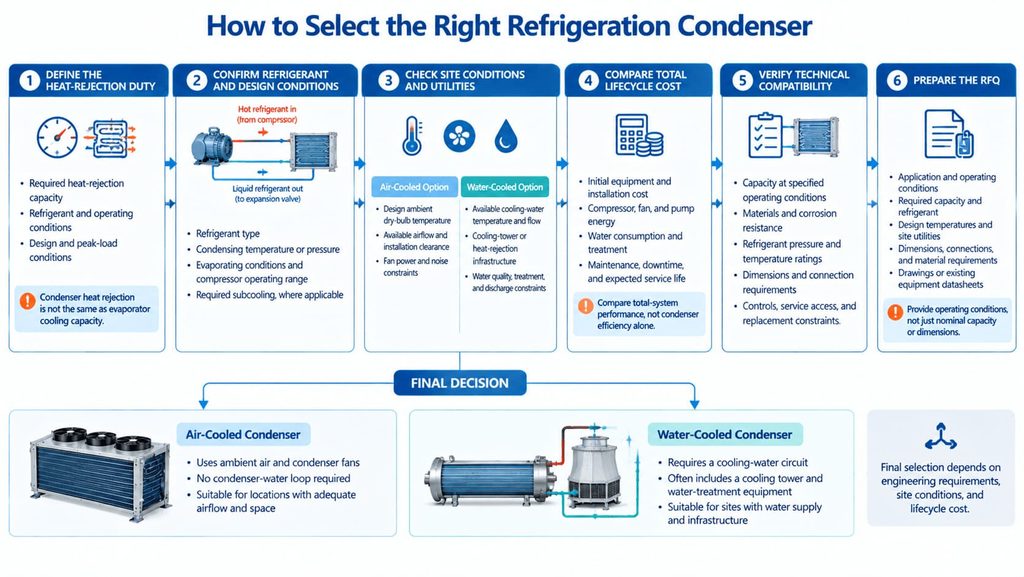
Step 1 — Define the Required Heat-Rejection Capacity
Begin with the required heat-rejection duty, not only the refrigeration capacity.
For a conventional system, condenser heat rejection is approximately the evaporator load plus compressor input, subject to the system configuration and independent heat-rejection paths.
Confirm whether the specified capacity is expressed in kW, refrigeration tons, or another unit. Also confirm whether the quoted capacity refers to the evaporator, condenser, or complete system.
Because the condenser and evaporator serve different roles in the same refrigeration circuit, their rated capacities should not be treated as interchangeable. If you are also evaluating the cooling load, evaporating conditions, or heat-transfer requirements on the low-pressure side, our guide to refrigeration evaporator design and selection explains the key parameters to review.
Step 2 — Confirm the Refrigerant and Operating Conditions
Provide the refrigerant and the design operating conditions, including:
- Evaporating temperature or pressure.
- Condensing temperature or pressure.
- Required liquid subcooling, where applicable.
- Expected superheat and other relevant inlet conditions.
- Design ambient-air temperature or cooling-water conditions.
- Allowable pressure drop.
- Operating pressure and applicable safety requirements.
These inputs directly affect the heat-transfer calculation and the condenser’s suitability. A capacity figure without its rating conditions cannot reliably predict performance in the actual system.
Step 3 — Evaluate the Site Environment and Utilities
Assess:
- Summer and winter design temperatures.
- Humidity and wet-bulb conditions where relevant.
- Water availability, quality, and cost.
- Space for equipment, piping, and service access.
- Dust, salt, grease, chemicals, and other corrosive exposure.
- Noise restrictions and airflow constraints.
- Electricity tariffs and operating schedules.
- Available maintenance staff and service resources.
For air-cooled equipment, pay particular attention to the entering-air condition and the possibility of hot-air recirculation. For water-cooled equipment, confirm the expected entering-water temperature and the availability of a suitable water-treatment program.
Step 4 — Compare Whole-System Energy and Lifecycle Cost
Obtain performance data for the proposed operating conditions. Estimate compressor power and all relevant auxiliary power, then calculate annual energy cost using the expected load profile.
For water-cooled options, add water consumption, treatment, and the costs of pumps and cooling-tower equipment. For both options, include installation, maintenance, replacement, and downtime risks.
If the preferred option changes when electricity prices, operating hours, or water costs change, document that sensitivity. It helps buyers understand the conditions under which each design is economically attractive.
Step 5 — Confirm Component Compatibility and Manufacturer Capability
Check the condenser’s compatibility with the system, including:
- Refrigerant and operating pressure.
- Heat-rejection capacity at the specified conditions.
- Tube and fin materials.
- Refrigerant and water connections, as applicable.
- Dimensional and installation constraints.
- Fan or pump requirements.
- Protection contre la corrosion.
- Applicable standards and documentation.
- Availability of drawings, performance data, and technical support.
Do not assume that a manufacturer supplying one condenser configuration can supply every type of water-cooled or air-cooled heat exchanger. Confirm the actual product range and engineering capability before comparing bids.
Once the operating conditions and compatibility requirements are clear, review our refrigeration condenser products to see the available configurations and technical information relevant to your application. For a replacement project or a custom requirement, confirm the required capacity, refrigerant, operating conditions, and connection details before selecting a model.
Step 6 — Prepare a Technical RFQ
A useful request for quotation (RFQ) gives suppliers enough information to assess performance and compatibility.
Recommended condenser RFQ checklist
| Information | What to provide |
|---|---|
| Demande | Refrigeration equipment, process, or end-use |
| Capacité requise | Required condenser heat rejection, with units |
| Réfrigérant | Exact refrigerant designation |
| Conditions d'utilisation | Evaporating and condensing temperatures or pressures |
| Ambient or water conditions | Design entering-air temperature or entering-water conditions |
| Flow requirements | Airflow or water flow, as relevant |
| Matériaux | Preferred or required tube, fin, and protective materials |
| Connexions | Connection sizes, locations, and requirements |
| Dimensions | Maximum envelope, installation space, and service clearance |
| Electrical requirements | Supply voltage, frequency, and control requirements |
| Conditions environnementales | Dust, salt, chemicals, humidity, or other exposure |
| Performance requirements | Capacity, pressure drop, fan power, or other acceptance criteria |
| Documentation | Drawings, technical datasheets, performance data, and applicable compliance documents |
| Quantity and schedule | Project quantity, target delivery, and required production schedule |
If available, attach a system schematic, equipment layout, existing condenser datasheet, or replacement-unit drawing. For replacement projects, the original model number is useful, but it should not replace verification of actual operating conditions.
Before comparing condenser cooling methods, it is also important to understand how condenser heat rejection requirements relate to compressor operating conditions.
Why Condenser Selection Should Be Based on Engineering Conditions
Why the Lowest Purchase Price May Not Be the Lowest Lifecycle Cost
A condenser that appears less expensive may have a higher operating cost if it requires greater compressor power, more auxiliary energy, or more frequent maintenance under the actual site conditions.
The opposite can also be true: a more complex water-cooled arrangement may have a higher initial cost without delivering enough energy savings to recover that cost during the project’s operating life.
The correct decision depends on verified performance at the required conditions, realistic operating hours, local utility costs, and the maintenance the site can actually deliver.
Buyers should be cautious about claims such as “high efficiency,” “low operating cost,” or “best performance” unless the supplier defines the rating conditions and provides data that can be compared with other proposals.
What to Request from a Condenser Manufacturer
Before placing an order, request:
- A technical datasheet showing the design refrigerant and operating conditions.
- Rated heat-rejection capacity at the specified conditions.
- The basis of the rating and the relevant ambient-air or water conditions.
- Pressure-drop information where applicable.
- Fan power or other auxiliary-power information relevant to the supplied equipment.
- Dimensional drawings and connection details.
- Material specifications and corrosion-protection details where required.
- Installation, operation, and maintenance instructions.
- Applicable compliance documentation and test information.
- Written confirmation of any deviations from the RFQ.
For a water-cooled condenser, also request the water-side flow and pressure-drop requirements, water-quality limitations, and cleaning recommendations.
For an air-cooled condenser, request the entering-air rating condition, airflow or fan data, coil construction, and any restrictions relevant to installation and cleaning.
Questions to Resolve Before Final Selection
Before approving the design, confirm that the engineering and purchasing teams agree on the answers to these questions:
- Is the required capacity the condenser’s heat-rejection duty or the evaporator’s cooling capacity?
- Are both proposals rated at the same refrigerant and operating conditions?
- What is the design entering-air temperature or entering-water temperature?
- Does the quotation include all necessary auxiliary equipment?
- Are pressure drop, fan power, and pump power available for comparison?
- What maintenance tasks and service intervals are expected?
- Are the materials suitable for the actual environment?
- Does the installation have sufficient space and service access?
- What documentation is required for approval and future maintenance?
- How will performance be verified during commissioning?
Resolving these questions before purchase reduces the risk of comparing incompatible equipment or selecting a condenser that meets a nominal capacity target but fails to meet the site’s real operating needs.
Frequently Asked Questions
What Is the Difference Between an Air-Cooled and a Water-Cooled Condenser?
An air-cooled condenser transfers refrigerant heat directly to air, usually through a finned coil and fans. A water-cooled condenser transfers refrigerant heat to water, which must then reject that heat through a cooling tower, another heat-rejection device, or an appropriate once-through arrangement. Their differences affect installation, operating conditions, energy consumption, water use, and maintenance.
What Is Better: Air-Cooled or Water-Cooled?
Neither is universally better. Air-cooled condensers often offer simpler installation and avoid condenser cooling-water requirements. Water-cooled condensers may offer lower condensing temperatures and lower whole-system electricity consumption under favorable conditions. The best option depends on climate, heat-rejection duty, water availability, operating hours, energy prices, and maintenance capability.
Are Water-Cooled Condensers More Energy-Efficient?
They can be, particularly when favorable cooling-water conditions reduce condensing temperature enough to lower compressor power. However, the comparison must include water pumps, cooling-tower fans, and other auxiliary loads. A water-cooled condenser does not automatically make the complete refrigeration system more efficient.
Are Air-Cooled Condensers Less Expensive to Operate?
Not always. Air-cooled systems may have lower infrastructure, water, and maintenance costs, but compressor power can increase under high ambient conditions. A water-cooled system may use less electricity in a suitable installation, while incurring water-treatment and cooling-tower costs. Annual operating cost must be calculated using actual site conditions and utility prices.
What Is the Typical Temperature Difference for an Air-Cooled Condenser?
There is no single temperature difference that applies to every condenser. A common measure is saturated refrigerant condensing temperature minus entering-air dry-bulb temperature. The required value depends on refrigerant, capacity, airflow, coil design, and rating conditions. Always compare figures stated at equivalent conditions.
What Does Condenser Approach Temperature Mean?
Condenser approach commonly refers to the difference between saturated refrigerant condensing temperature and leaving condenser-water temperature in a water-cooled system. Cooling-tower approach is different: it is commonly defined as leaving tower-water temperature minus entering-air wet-bulb temperature. Confirm the supplier’s definition before comparing data.
What Are the Three Main Types of Water-Cooled Condensers?
Common water-cooled condenser configurations include shell-and-tube, shell-and-coil, and tube-in-tube designs. Brazed-plate heat exchangers are also used in suitable applications. Selection depends on capacity, refrigerant, pressure rating, flow, fouling, material compatibility, and maintenance requirements.
What Are the Main Types of Air-Cooled Condensers?
Air-cooled condensers can use forced-draft or induced-draft airflow and may have horizontal, vertical, or A-frame coil arrangements. They may be supplied as remote condensers or integrated into condensing units. Finned-tube and microchannel constructions are available for different applications, subject to compatibility and performance requirements.
Why Are Air-Cooled Condensers Common in Commercial Refrigeration?
They avoid the need for a dedicated condenser-water system, can simplify installation, and do not require routine condenser cooling-water consumption. These advantages make them practical for many commercial refrigeration applications. Their performance still depends on outdoor temperature, airflow, coil cleanliness, and appropriate sizing.
Do Water-Cooled Condensers Require Chemical Cleaning?
Not necessarily on a fixed universal schedule. Cleaning requirements depend on water quality, fouling, materials, operating conditions, and the manufacturer’s recommendations. Water-treatment chemicals help control scale, corrosion, and biological growth, but they do not replace inspection and cleaning. Chemical cleaning must use a method compatible with the heat exchanger and its materials.
What Is the Difference Between a Condenser and a Chiller?
A condenser is a heat exchanger that rejects heat from refrigerant to air or another cooling medium. A chiller is a complete refrigeration machine designed to cool a fluid, typically using a compressor, evaporator, condenser, controls, and associated components. A chiller may use an air-cooled or water-cooled condenser.
Is an Evaporative Condenser the Same as a Water-Cooled Condenser?
No. A conventional water-cooled condenser transfers heat from refrigerant to water, and the water then rejects heat elsewhere. An evaporative condenser typically transfers refrigerant heat through a coil while water is distributed over the coil and air moves through the equipment. Evaporation contributes directly to heat rejection in the evaporative condenser.
Conclusion: Choose the Condenser Around the Entire System
The choice between an air-cooled condenser and a water-cooled condenser should begin with the required heat-rejection duty and the operating conditions—not with a general assumption that one type is always cheaper or more efficient.
Air-cooled condensers often offer a simpler installation, avoid the need for condenser cooling water, and reduce the number of supporting components. Water-cooled condensers may achieve lower condensing temperatures and reduce compressor power when cooling-water conditions are favorable, and the complete water system is properly designed and maintained.
The decision should account for:
- Required heat-rejection capacity.
- Refrigerant and evaporating and condensing conditions.
- Design ambient-air or cooling-water conditions.
- Compressor and auxiliary power.
- Water availability and treatment requirements.
- Installation space and maintenance capability.
- Initial cost, annual operating cost, and lifecycle risk.
For B2B buyers, the most reliable approach is to compare proposals using the same operating conditions, clearly defined rating data, and a complete view of the system’s energy and maintenance requirements.
Need Help Selecting a Refrigeration Condenser?
Choosing a condenser for an OEM system, replacement project, or industrial refrigeration application requires more than matching dimensions or nominal capacity.
Share the following information with our team:
- Application and equipment type.
- Required heat-rejection capacity.
- Réfrigérant.
- Evaporating and condensing temperatures or pressures.
- Design ambient-air temperature or cooling-water conditions.
- Airflow or water-flow requirements, where applicable.
- Installation dimensions and connection requirements.
- Material, corrosion resistance, and other technical requirements.
- Existing drawings or datasheets, if this is a replacement project.
Our team can review the information and discuss a suitable condenser configuration for your refrigeration system.
Nous contacter for Refrigeration Condenser Selection