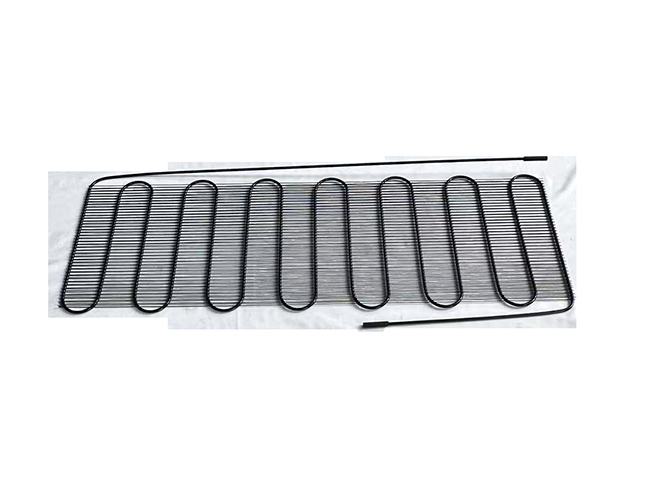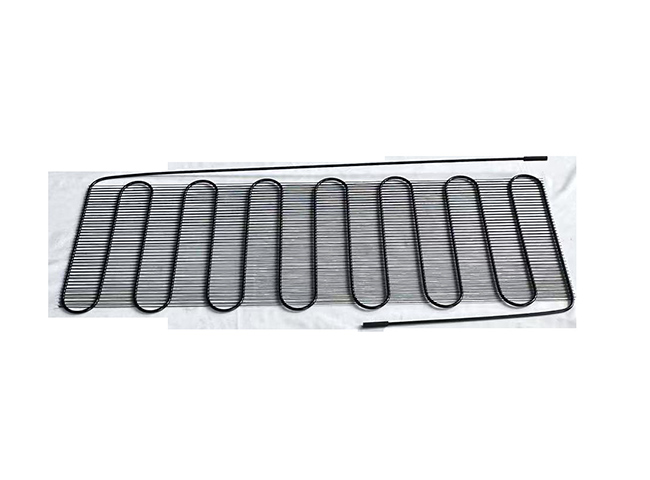
A refrigeration condenser is one of the most important components in a refrigeration system. It removes heat from high-pressure refrigerant vapor and transfers that heat to the surrounding air, cooling water, or another heat-rejection medium.
For refrigeration equipment manufacturers, OEM buyers, HVAC-R contractors, and refrigeration parts distributors, selecting the right condenser is not simply about finding a coil with the correct dimensions. The condenser must be capable of rejecting the required heat load under the actual operating conditions of the refrigeration system.
A condenser that is too small may cause high condensing pressure, increased compressor power consumption, and reduced cooling capacity. A condenser that is poorly matched to the refrigerant, airflow, water flow, or installation environment may also create problems that are difficult to diagnose after the equipment has been assembled.
This guide explains what a refrigeration condenser is, where it is located, how it works, the different types of condensers used in refrigeration systems, how to size a condenser, what materials are commonly used, how condensers are installed and maintained, and what buyers should check before placing an order.
Whether you are sourcing a replacement refrigerator condenser, developing an OEM refrigeration unit, or purchasing custom condenser coils for an industrial application, the goal is the same: obtain a heat exchanger that delivers reliable performance under the intended working conditions.
Was ist ein Kühlkondensator?
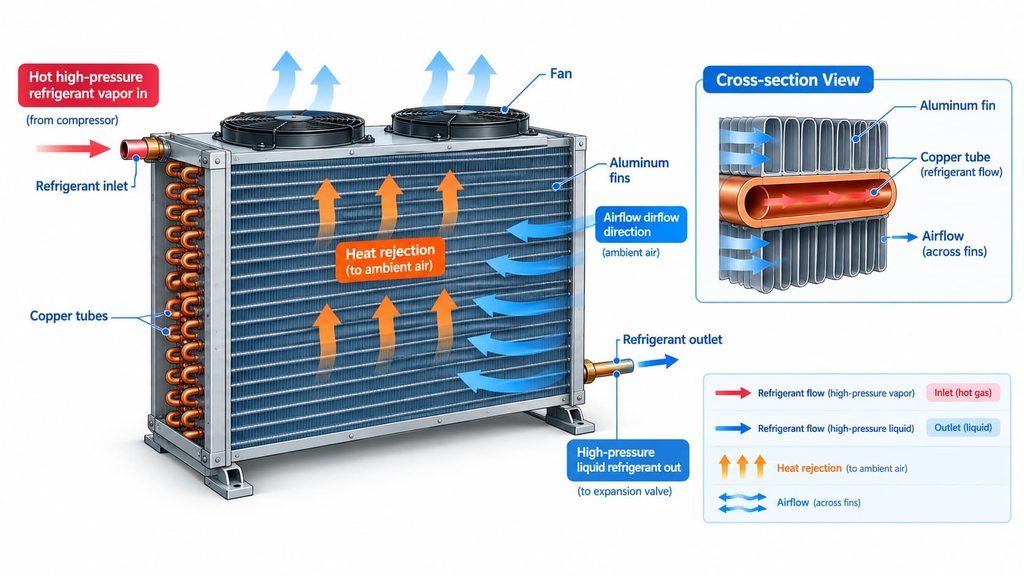
A refrigeration condenser is a heat exchanger that removes heat from refrigerant and changes it from a vapor into a liquid.
The refrigerant entering the condenser is normally a high-pressure, high-temperature vapor discharged by the compressor. As the refrigerant flows through the condenser, heat is transferred from the refrigerant to a cooler medium.
Depending on the condenser design, this cooling medium may be:
- Ambient air
- Cooling water
- Evaporatively cooled air and water
- Another refrigerant in certain cascade systems
The refrigerant releases heat in three main stages:
- Desuperheating of the hot refrigerant vapor.
- Condensation of the refrigerant from vapor to liquid.
- Subcooling of the liquid refrigerant, when the design includes a subcooling section.
What Is the Function of a Condenser in a Refrigeration System?
The main function of a condenser in a refrigeration system is to reject heat.
That heat includes:
- Heat absorbed by the evaporator.
- Heat added to the refrigerant during compression.
- Heat removed from the refrigerant during desuperheating, condensation, and subcooling.
This is why condenser heat rejection is normally greater than the refrigeration capacity of the evaporator.
For example, if a refrigeration system provides 100 kW of cooling capacity, the condenser may need to reject more than 100 kW of heat, depending on compressor power and operating conditions.
According to engineering guidance, a refrigeration condenser rejects the heat absorbed by the evaporator plus the energy input to the compressor. The condenser’s total heat rejection is therefore a critical value for selecting the correct component.
Where Is the Condenser Located in a Refrigeration System?
The condenser is located on the high-pressure side of a vapor-compression refrigeration system, between the compressor discharge and the expansion device.
A typical refrigeration system follows this sequence:
Compressor → Condenser → Expansion Valve → Evaporator → Compressor
The exact physical location depends on the equipment design.
Refrigerator Condenser Location
In a household refrigerator, the condenser may be:
- Mounted on the back of the cabinet.
- Installed underneath the refrigerator.
- Integrated into the cabinet walls.
- Designed as a hot-wall condenser.
In older refrigerator designs, a condenser coil is often visible on the rear panel. In newer designs, the condenser may be concealed beneath the cabinet or integrated into the side walls.
Commercial Refrigeration Condenser Location
In commercial refrigeration equipment, the condenser may be:
- Mounted on the top of the unit.
- Installed at the bottom of the cabinet.
- Located in a remote condensing unit.
- Installed outdoors as part of a centralized refrigeration system.
Industrial Refrigeration Condenser Location
Industrial refrigeration condensers are often installed in dedicated mechanical rooms, outdoor equipment areas, or rooftop plant rooms.
The location should provide sufficient airflow or water flow, appropriate service access, and a suitable environment for the heat exchanger and associated components.
Why Condenser Location Matters
A condenser must reject heat to its surroundings. If the surrounding air or cooling water is already too warm, the condenser may not be able to achieve the required condensing temperature.
For air-cooled condensers, poor installation can cause:
- Recirculation of hot discharge air.
- Insufficient airflow.
- Increased condensing pressure.
- Higher compressor power consumption.
- Reduced system cooling capacity.
Unusual or congested installation locations can produce higher entering-air temperatures than general ambient conditions. Condenser air recirculation is often associated with poor installation layout.
What Does the Condenser Do in the Refrigeration Cycle?
The condenser performs the heat-rejection stage of the refrigeration cycle.
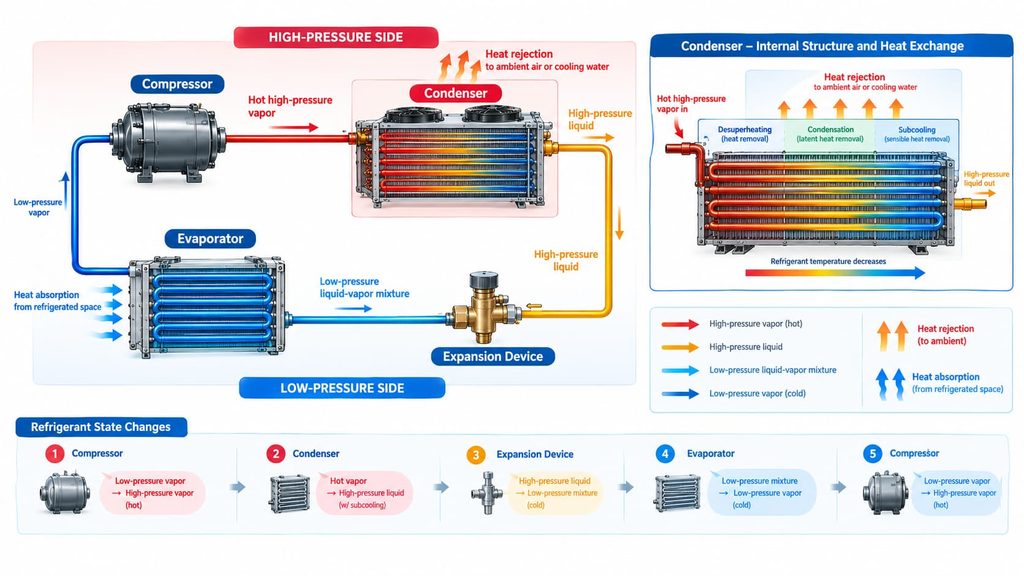
Basic Refrigeration Cycle
A standard vapor-compression refrigeration system contains four major components:
- Kompressor
- Kondensator
- Dehnungsvorrichtung
- Verdampfer
The refrigerant circulates continuously through these components.
Step 1: Compressor
The compressor receives low-pressure refrigerant vapor from the evaporator.
It compresses the vapor to a higher pressure and temperature.
The refrigerant then enters the condenser as a hot, high-pressure vapor.
Step 2: Condenser
The condenser removes heat from the refrigerant.
The refrigerant cools and condenses into a high-pressure liquid.
Step 3: Expansion Device
The high-pressure liquid passes through an expansion valve or another metering device.
The pressure drops, and the refrigerant becomes a low-pressure, low-temperature mixture.
Step 4: Evaporator
The refrigerant absorbs heat from the refrigerated space or process.
It evaporates into vapor and returns to the compressor.
The cycle then repeats.
As It Passes Through the Condenser, the Refrigerant Is…
The refrigerant changes from a high-pressure, high-temperature vapor into a high-pressure liquid.
More precisely, the refrigerant usually passes through these states:
Superheated vapor → Saturated vapor → Two-phase mixture → Saturated liquid → Subcooled liquid
The exact refrigerant condition depends on the condenser design and operating conditions.
When Refrigerant Enters the Condenser, What State Is It In?
Under normal vapor-compression refrigeration operation, the refrigerant entering the condenser is a high-pressure vapor, often superheated above its saturation temperature.
The refrigerant has just left the compressor.
Its temperature is normally higher than the condensing temperature because the compressor adds energy to the refrigerant.
Does a Condenser Reject Heat?
Yes.
Heat rejection is the primary function of a refrigeration condenser.
The condenser transfers heat from the refrigerant to a cooling medium.
For an air-cooled condenser, the heat flows from the refrigerant through the tube wall and fins into the air.
For a water-cooled condenser, the heat flows from the refrigerant through the heat exchanger wall into the cooling water.
For an evaporative condenser, heat is rejected through a combination of air movement and water evaporation.
Why Is a Refrigeration Condenser Important?
A condenser is essential because the refrigeration cycle cannot continue without rejecting the heat absorbed by the evaporator.
If the condenser cannot remove enough heat, the high-side pressure may increase and the system may become inefficient or unable to operate.
1. It Removes Heat from the Refrigeration System
The condenser is responsible for releasing heat from the refrigerant.
Without this process, the refrigerant would not return to the appropriate liquid condition for the expansion device.
2. It Supports Stable Condensing Pressure
The condenser must maintain suitable condensing conditions under different operating loads and ambient temperatures.
Poor heat rejection can cause high head pressure and unstable system operation.
3. It Influences Compressor Power Consumption
As condensing pressure increases, the compressor may require more energy to raise the refrigerant from suction pressure to discharge pressure.
This is one reason why condenser performance directly affects operating costs.
4. It Helps Maintain Refrigeration Capacity
An appropriately selected condenser helps the system maintain the intended refrigeration capacity.
An undersized condenser may reduce the system’s ability to achieve the required cooling temperature.
5. It Influences Equipment Reliability
High condensing pressure and discharge temperature can increase stress on the compressor and other components.
A suitable condenser design helps keep the system within its intended operating envelope.
Wie funktioniert ein Kühlkondensator?
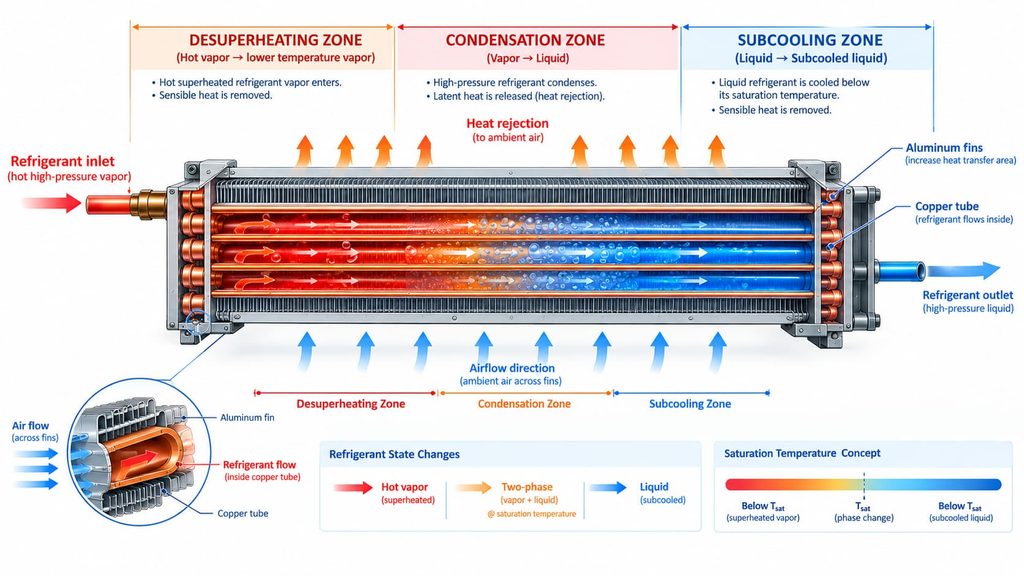
A refrigeration condenser works by transferring heat from refrigerant to a cooler medium.
The process is normally divided into three heat-transfer zones.
1. Desuperheating Zone
Hot refrigerant vapor enters the condenser from the compressor.
At this stage, the refrigerant temperature is above its saturation temperature.
The condenser removes sensible heat from the vapor until it approaches the saturation condition.
2. Condensation Zone
The refrigerant reaches its saturation condition.
Heat is removed from the refrigerant while it changes from vapor to liquid.
This phase change is the main heat-transfer process in many refrigeration condensers.
In a typical water-cooled condenser example, the condensation stage accounts for approximately 83% of total heat rejection under the stated operating conditions.
This percentage is not a universal value for every condenser. The actual share depends on refrigerant, superheat, subcooling, flow arrangement, and operating conditions.
3.Subcooling Zone
After the refrigerant becomes liquid, additional heat may be removed.
Die Temperatur der Flüssigkeit fällt unter ihre Sättigungstemperatur.
Dies wird als Unterkühlung bezeichnet.
Subcooling can help reduce the risk of flash gas forming in the liquid line before the expansion device.
The amount of subcooling required depends on system design and manufacturer specifications.
Refrigeration Condenser Heat Transfer Formula
Eine vereinfachte Gleichung für die Wärmeübertragung lautet:
Q = U × A × ΔT
Wo:
- Q = heat-transfer rate.
- U = overall heat-transfer coefficient.
- A = effective heat-transfer area.
- ΔT = effective temperature difference.
This formula helps explain why condenser performance depends on more than the external dimensions of the coil.
A condenser with more tubes is not automatically better if the refrigerant distribution, airflow, fin design, or operating temperature is unsuitable.
Types of Condensers Used in Refrigeration Systems
Refrigeration condensers are commonly classified according to the cooling medium.
The three major types are:
- Air-cooled condenser.
- Water-cooled condenser.
- Evaporative condenser.
Other specialized designs are used in cascade systems and heat-recovery applications.
Air-Cooled Refrigeration Condenser
An air-cooled condenser rejects heat to ambient air.
It commonly consists of:
- Copper tubes.
- Aluminum fins.
- Steel frame.
- Headers.
- Fan or fans.
- Fan motor.
- Refrigerant inlet and outlet connections.
The refrigerant flows through the tubes while air passes over the external fin surface.
Advantages of Air-Cooled Condensers
- Simple installation.
- No cooling-water circuit required.
- Suitable for many commercial refrigeration systems.
- Relatively straightforward maintenance.
- Suitable for modular refrigeration equipment.
- Can be manufactured in customized coil dimensions.
Applications of Air-Cooled Condensers
Air-cooled condensers are used in:
- Refrigerators.
- Freezers.
- Cold rooms.
- Commercial display cases.
- Refrigeration condensing units.
- HVAC systems.
- Small and medium industrial refrigeration systems.
- Outdoor refrigeration equipment.
Air-Cooled Condenser Selection Considerations
Important parameters include:
- Refrigeration capacity.
- Refrigerant type.
- Ambient temperature.
- Condensing temperature.
- Airflow.
- Fan diameter.
- Fan speed.
- Fin spacing.
- Tube diameter.
- Heat-transfer surface.
- Installation dimensions.
- Corrosion environment.
Air-cooled condenser selection must consider the design entering-air temperature. Higher entering-air temperature can increase discharge pressure and compressor power.
Water-Cooled Refrigeration Condenser
A water-cooled condenser transfers heat from the refrigerant to cooling water.
Common designs include:
- Shell-and-tube condenser.
- Tube-in-tube condenser.
- Brazed plate heat exchanger.
- Plate-and-frame heat exchanger.
The refrigerant condenses on one side of the heat exchanger while water absorbs heat on the other side.
Advantages of Water-Cooled Condensers
- Compact construction.
- High heat-transfer performance.
- Suitable for many industrial applications.
- Less directly dependent on ambient air temperature.
- Can be suitable for larger refrigeration systems.
Disadvantages
- Requires a suitable water supply or cooling circuit.
- Water quality must be controlled.
- Scaling and fouling may reduce performance.
- Water-side pressure drop must be considered.
- Maintenance may be more complex.
Applications of Water-Cooled Condensers
Water-cooled condensers are commonly used in:
- Industrial chillers.
- Process cooling systems.
- Large refrigeration equipment.
- Central refrigeration plants.
- Water-cooled HVAC systems.
- Industrial heat-recovery systems.
Evaporative Refrigeration Condenser
An evaporative condenser uses both air movement and water evaporation to reject heat.
Water is distributed over a heat-transfer surface while air flows through the condenser.
As water evaporates, it removes heat from the system.
Evaporative condensers are often used where high heat rejection is required and water availability and maintenance can be managed.
Vorteile
- Can provide effective heat rejection.
- Can reduce condensing temperature under suitable conditions.
- Can be more compact than some air-cooled alternatives.
- Suitable for certain larger refrigeration applications.
Disadvantages
- Requires water management.
- Water treatment may be necessary.
- Scaling and corrosion can affect performance.
- Requires regular maintenance.
- Water consumption must be considered.
Other Specialized Condenser Designs
Some refrigeration systems use specialized arrangements such as:
- Cascade condensers.
- Heat-recovery condensers.
- Integrated subcooling condensers.
- Hot-wall condensers.
- Multiple condenser circuits.
- Refrigerant-to-refrigerant heat exchangers.
A hot-wall condenser, for example, may be integrated into the cabinet walls of a domestic refrigerator.
This type of design can use the refrigerator’s external surfaces to reject heat without a conventional fan-cooled coil.
Refrigeration Condenser Materials: What Are They Made Of?
The materials used in a refrigeration condenser depend on the refrigerant, cooling medium, operating pressure, corrosion environment, manufacturing method, and application.
Common materials include:
- Copper.
- Aluminum.
- Steel.
- Stainless steel.
- Brass.
- Copper alloys.
Copper Tubes
Copper is widely used in refrigeration heat exchangers because of its high thermal conductivity and suitability for many refrigeration applications.
Common uses include:
- Finned-tube condenser coils.
- Refrigerant tubing.
- Headers.
- Connections.
- Heat exchanger circuits.
Copper is not automatically suitable for every application. The refrigerant, operating pressure, water chemistry, and corrosion conditions must be checked.
Aluminum Fins
Aluminum fins are commonly used in air-cooled condenser coils.
The fins increase the external heat-transfer surface area.
Fin performance depends on:
- Fin thickness.
- Fin spacing.
- Fin shape.
- Fin contact with the tube.
- Air velocity.
- Surface condition.
Steel Frame
Steel is commonly used for:
- Mounting brackets.
- Coil support.
- Fan support.
- Protective frames.
- Cabinet structures.
The steel may require a suitable coating or surface treatment depending on the installation environment.
Stainless Steel
Stainless steel may be selected for certain applications where corrosion resistance, durability, or specific fluid compatibility is important.
It is not necessarily the most economical material for every condenser design.
Why Material Selection Matters
Material selection affects:
- Heat-transfer performance.
- Corrosion resistance.
- Pressure resistance.
- Brazing or welding requirements.
- Service life.
- Manufacturing cost.
- Compatibility with refrigerant and cooling medium.
A supplier should confirm the actual material grade, tube wall thickness, fin material, and applicable pressure requirements for the specific design.
Refrigeration Condenser Sizing: How to Size a Condenser
Condenser sizing is one of the most important steps in refrigeration system design.
The condenser must be capable of rejecting the total heat load under the specified operating conditions.
The most common mistake is to select a condenser based only on evaporator refrigeration capacity.
The condenser must reject both the evaporator load and the compressor’s heat input.
Step 1 — Determine Refrigeration Capacity
Start with the required refrigeration capacity.
Common units include:
- kW.
- BTU/h.
- Refrigeration tons.
- kcal/h.
A useful conversion is:
1 Kältetonne ≈ 3,517 kW
Daher:
10 TR ≈ 35,17 kW
This is a conversion of capacity units, not a complete condenser selection method.
Step 2 — Determine Total Heat Rejection
The condenser heat rejection is greater than the evaporator load because the compressor adds energy to the refrigerant.
A simplified relationship is:
Condenser Heat Rejection = Refrigeration Capacity + Compressor Heat Input
For an idealized example:
- Refrigeration capacity = 100 kW.
- Compressor heat input = 25 kW.
Then:
Condenser heat rejection = 125 kW
This is an illustrative calculation. Actual compressor heat input must be determined from the compressor performance data and operating conditions.
Step 3 — Determine Condensing Temperature
The condensing temperature is a critical parameter.
For air-cooled condensers, it is related to:
- Ambient dry-bulb temperature.
- Airflow.
- Heat-transfer area.
- Refrigerant.
- Condenser design.
For water-cooled condensers, it is related to:
- Entering water temperature.
- Leaving water temperature.
- Water flow rate.
- Heat-transfer area.
- Fouling conditions.
Selecting condensers using the intended design conditions rather than assuming that a general outdoor temperature is always suitable.
Step 4 — Determine the Temperature Difference
The condenser needs a sufficient temperature difference between the refrigerant and cooling medium.
A larger temperature difference can increase heat transfer, but it may also increase condensing temperature and compressor energy consumption.
A smaller temperature difference may improve efficiency but require a larger heat-transfer surface.
For this reason, condenser sizing is a balance between:
- Heat rejection capacity.
- Physical size.
- Operating efficiency.
- Cost.
- Installation restrictions.
Step 5 — Determine Heat-Transfer Area
A simplified heat-transfer formula is:
A = Q / (U × ΔT)
Wo:
- A = required heat-transfer area.
- Q = heat rejection.
- U = overall heat-transfer coefficient.
- ΔT = effective temperature difference.
The actual design may require more detailed calculations involving logarithmic mean temperature difference, refrigerant-side heat transfer, air-side heat transfer, pressure drop, fin efficiency, and fouling factors.
Step 6 — Check Pressure Drop
Pressure drop must be considered on both the refrigerant side and cooling-medium side.
Excessive pressure drop can affect:
- Condensing pressure.
- Refrigerant distribution.
- System capacity.
- Compressor operation.
- Fan or pump power.
The acceptable pressure drop depends on the refrigeration system and manufacturer specifications.
Refrigerator Condenser Size Chart
A refrigerator condenser size chart can be useful for preliminary product selection, but it should not be treated as a universal engineering standard.
Different refrigerators may use different refrigerants, compressor capacities, operating temperatures, and condenser designs.
The following table is a preliminary selection guide, not a manufacturer-certified performance chart.
| Anwendung | Typical condenser design | Main sizing inputs |
| Household refrigerator | Wire-on-tube, plate-on-tube, or hot-wall design | Compressor capacity, cabinet design, ambient temperature |
| Small freezer | Compact air-cooled condenser | Refrigeration capacity, low-temperature operating conditions |
| Commercial refrigerator | Finned-tube condenser | Compressor capacity, ambient temperature, airflow |
| Walk-in cold room | Remote air-cooled condenser | Refrigeration load, refrigerant, condensing temperature |
| Industrial refrigeration | Air-cooled or water-cooled condenser | Total heat rejection, refrigerant, water/air conditions |
| Large chiller | Water-cooled or air-cooled heat exchanger | System capacity, entering water/air temperature, flow rate |
Important Sizing Warning
Two condensers with identical dimensions may have different thermal capacities.
For example, the following design differences can change performance:
- Tube diameter.
- Tube wall thickness.
- Number of tube rows.
- Fin spacing.
- Fin thickness.
- Refrigerant circuiting.
- Refrigerant type.
- Airflow.
- Condensing temperature.
Therefore, buyers should request a performance rating under defined operating conditions.
Refrigeration Condenser Design: Engineering Considerations
Designing a condenser requires more than calculating heat-transfer area.
The condenser must be designed around the complete refrigeration system.
Refrigerant Compatibility
The refrigerant affects:
- Operating pressure.
- Refrigerant mass flow.
- Heat-transfer behavior.
- Material compatibility.
- Safety requirements.
- Required design pressure.
The condenser must be suitable for the specific refrigerant and operating envelope.
Refrigerant Circuit Design
Circuit arrangement influences:
- Refrigerant distribution.
- Pressure drop.
- Heat-transfer performance.
- Oil return.
- Condenser capacity.
A well-designed circuit should distribute refrigerant appropriately across the available heat-transfer surface.
Airflow Design
For air-cooled condensers, airflow is a major performance factor.
Important parameters include:
- Fan size.
- Fan speed.
- Air volume.
- Air velocity.
- Fin pitch.
- Coil resistance.
- Air inlet and outlet layout.
A condenser with a large heat-transfer surface may still perform poorly if airflow is insufficient.
Water Flow Design
For water-cooled condensers, water flow and water quality are important.
The design should consider:
- Water inlet temperature.
- Water outlet temperature.
- Flow rate.
- Water pressure drop.
- Fouling.
- Scaling.
- Corrosion.
Subcooling Design
If the condenser includes a subcooling section, the design should account for the intended liquid outlet condition.
Subcooling can improve liquid-line stability, but the amount required depends on the system design.
Design Pressure and Safety
The condenser must be designed for the refrigerant’s pressure and the expected operating conditions.
Applicable safety requirements, pressure regulations, material specifications, and testing procedures should be confirmed by the manufacturer and equipment designer.
Condenser design pressure and the need to account for operating and standby conditions.
How Is a Refrigeration Condenser Installed?
Condenser installation depends on the type of condenser and the refrigeration equipment.
Air-Cooled Condenser Installation
Typical installation considerations include:
- Install the condenser in a suitable location.
- Ensure adequate airflow.
- Avoid hot-air recirculation.
- Provide access for cleaning and service.
- Connect refrigerant piping correctly.
- Follow the equipment manufacturer’s pressure and leak-testing procedures.
- Confirm fan rotation and electrical connections.
- Check operating pressures and temperatures during commissioning.
Water-Cooled Condenser Installation
Water-cooled condenser installation requires:
- Correct water inlet and outlet connections.
- Appropriate water flow.
- Suitable piping.
- Water filtration or treatment where required.
- Adequate service access.
- Correct refrigerant connections.
- Pressure and leak testing.
Refrigerant Piping Considerations
Incorrect piping may lead to:
- Excessive pressure drop.
- Poor refrigerant return.
- Liquid-line flash gas.
- Oil return problems.
- Reduced refrigeration capacity.
The condenser should be installed according to the complete system design rather than as an isolated component.
Refrigeration Condenser Practical Applications
Refrigeration condensers are used across many industries.
Household Refrigeration
Zu den Anwendungsbereichen gehören:
- Domestic refrigerators.
- Freezers.
- Wine coolers.
- Compact refrigeration units.
The condenser may be integrated into the cabinet or installed as a compact coil.
Gewerbliche Kältetechnik
Zu den Anwendungsbereichen gehören:
- Supermarket refrigeration.
- Display cases.
- Commercial freezers.
- Beverage coolers.
- Ice machines.
- Refrigerated storage.
Commercial systems may use air-cooled condensers or remote condensing units.
Cold Storage
Cold storage facilities use condensers to reject heat from refrigeration systems serving:
- Chilled food storage.
- Frozen food storage.
- Pharmaceutical storage.
- Temperature-controlled warehouses.
Industrial Refrigeration
Industrial applications include:
- Process cooling.
- Food processing.
- Beverage production.
- Chemical processing.
- Industrial chillers.
- Large cold rooms.
Industrial systems often require customized condenser designs based on capacity, refrigerant, and operating conditions.
HVAC and Chiller Systems
Condensers are used in:
- Air-conditioning systems.
- Water chillers.
- Rooftop equipment.
- Commercial HVAC systems.
- Industrial cooling plants.
The correct condenser type depends on the system design and heat-rejection method.
What Causes a Refrigerator Condenser to Go Bad?
A refrigeration condenser may experience performance problems due to several causes.
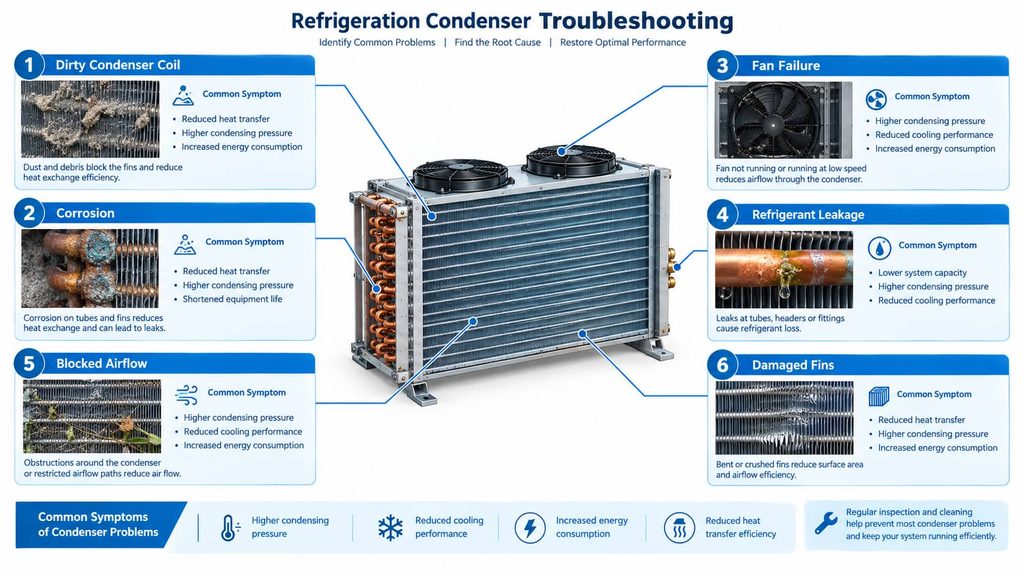
Dirty Condenser Coil
Dust and dirt can reduce airflow and decrease heat-transfer performance.
Korrosion
Corrosion may affect:
- Tubes.
- Fins.
- Headers.
- Connections.
- Mounting structures.
The risk depends on the environment and materials.
Fan Failure
A failed fan or fan motor can reduce airflow across an air-cooled condenser.
This may cause high condensing pressure and poor cooling performance.
Refrigerant Leakage
A leak may occur at:
- Tube joints.
- Brazed connections.
- Headers.
- Damaged tubing.
- Corroded components.
A refrigerant leak requires qualified service personnel to identify and repair the cause.
Blocked Airflow
Improper installation or obstructions can reduce heat rejection.
Water-Side Fouling
For water-cooled condensers, scale or fouling can reduce heat-transfer performance and increase pressure drop.
How to Tell If a Refrigerator Condenser Is Working
A condenser should be evaluated as part of the entire refrigeration system.
Possible signs of condenser performance problems include:
- High condensing pressure.
- High compressor discharge temperature.
- Reduced cooling capacity.
- Excessive compressor running time.
- Unusual fan operation.
- Poor airflow.
- Abnormal temperature difference.
- Water-side flow problems.
However, these symptoms can also be caused by other issues such as refrigerant charge, compressor condition, expansion-device problems, or airflow restrictions.
Basic Inspection
For a qualified technician, inspection may include:
- Checking the condenser coil condition.
- Confirming fan operation.
- Measuring operating pressures.
- Measuring refrigerant temperatures.
- Checking airflow or water flow.
- Inspecting for leakage.
- Comparing operating conditions with the equipment manufacturer’s specifications.
A refrigerator condenser that feels warm is not necessarily faulty. Condensers are designed to reject heat, so warming is expected during normal operation.
How Long Does a Refrigerator Condenser Last?
There is no single universal lifespan for every refrigeration condenser.
Service life depends on:
- Material.
- Refrigerant.
- Operating pressure.
- Ambient conditions.
- Corrosion exposure.
- Coil cleanliness.
- Installation quality.
- Vibration.
- Maintenance.
- System operating conditions.
A properly selected and maintained condenser may remain in service for many years, but a specific service-life guarantee must come from the manufacturer under defined conditions.
For B2B buyers, it is more useful to evaluate:
- Material specifications.
- Pressure-test requirements.
- Corrosion protection.
- Manufacturing quality.
- Design operating envelope.
- Warranty conditions.
- Replacement availability.
How Long Can a Refrigerator Run With a Bad Condenser?
A refrigeration system should not be operated indefinitely when the condenser is confirmed to be defective or unable to reject heat properly.
A faulty condenser may cause:
- High head pressure.
- Increased compressor temperature.
- Reduced cooling.
- Increased energy consumption.
- Protective shutdown.
- Compressor damage if unsafe operating conditions persist.
The safe operating time depends on the actual fault and equipment protection.
If a condenser is severely blocked, leaking, or unable to reject heat, the system should be inspected by a qualified technician.
Refrigerator Condenser Replacement Cost
The cost to replace a refrigerator condenser depends on the equipment and the scope of work.
Factors include:
- Condenser type.
- Refrigerator or refrigeration unit size.
- Coil dimensions.
- Refrigerant.
- Material.
- Replacement availability.
- Labor.
- Refrigerant recovery and recharge.
- Leak testing.
- Access to the component.
A standard replacement coil may be relatively simple to source, while a custom coil for an older or specialized refrigeration unit may require engineering and manufacturing.
For B2B buyers, replacement cost should be evaluated together with:
- Product quality.
- Expected service life.
- Installation compatibility.
- Refrigeration capacity.
- Lead time.
- Warranty.
- Total cost of ownership.
How to Clean a Refrigerator Condenser
Condenser cleaning should follow the equipment manufacturer’s instructions.
For air-cooled condensers, cleaning may involve:
- Removing dust and debris.
- Cleaning the fin surface.
- Checking fan operation.
- Inspecting the coil for corrosion.
- Ensuring sufficient airflow.
For water-cooled condensers, cleaning may involve:
- Inspecting water-side fouling.
- Checking water quality.
- Monitoring pressure drop.
- Using an appropriate cleaning procedure.
Cleaning methods must be selected carefully to avoid damaging fins, tubes, coatings, or electrical components.
Maintenance Considerations
A suitable condenser maintenance program may include:
| Maintenance item | Air-cooled condenser | Water-cooled condenser |
| Coil cleaning | Important | External surfaces where applicable |
| Airflow check | Important | Not applicable |
| Fan inspection | Important | Not applicable |
| Water flow check | Not applicable | Important |
| Wasserqualität | Not applicable | Important |
| Corrosion inspection | Important | Important |
| Pressure monitoring | Important | Important |
| Leak inspection | Important | Important |
| Mounting inspection | Important | Important |
| Performance review | Important | Important |
The actual maintenance interval should be determined by the equipment manufacturer and operating environment.
How to Compare Refrigeration Condenser Suppliers
When comparing condenser suppliers, price alone is not enough.
A lower-priced condenser may have different:
- Heat-transfer capacity.
- Tube material.
- Fin design.
- Circuit arrangement.
- Pressure rating.
- Coating.
- Testing procedures.
- Warranty.
- Lead time.
What Should You Request from a Condenser Manufacturer?
Bevor Sie ein Angebot anfordern, halten Sie bitte folgende Informationen bereit:
Product Requirements
- Condenser type.
- Application.
- Required capacity.
- Refrigerant.
- Condensing temperature.
- Ambient or water temperature.
- Airflow or water flow.
- Installation dimensions.
- Connection specifications.
Technical Requirements
- Tube material.
- Fin material.
- Tube diameter.
- Tube wall thickness.
- Fin spacing.
- Number of rows.
- Circuit arrangement.
- Design pressure.
- Test pressure.
- Corrosion protection.
- Required accessories.
Commercial Requirements
- Quantity.
- Target delivery time.
- Packaging.
- Shipping destination.
- Warranty.
- OEM requirements.
- Required documentation.
Why Customized Condenser Design May Be Necessary
Standard condenser coils are useful when the application matches the available specifications.
However, customized designs may be necessary when the buyer has:
- Limited installation space.
- Special refrigerant requirements.
- Unusual operating temperatures.
- Corrosive installation conditions.
- Specific connection positions.
- Special airflow requirements.
- OEM cabinet dimensions.
- A particular heat-rejection target.
A custom condenser should be evaluated using actual engineering conditions, not just the external size.
Refrigeration Condenser Buying Checklist
Before placing an order, confirm:
- Refrigerant type.
- Required refrigeration capacity.
- Total heat rejection.
- Condensing temperature.
- Ambient or entering-water temperature.
- Airflow or water flow.
- Pressure drop.
- Material specifications.
- Tube diameter.
- Fin spacing.
- Coil dimensions.
- Connection sizes.
- Design pressure.
- Pressure testing.
- Leak testing.
- Corrosion protection.
- Fan and motor requirements.
- Mounting requirements.
- Packaging.
- Delivery time.
- Warranty and documentation.
Frequently Asked Questions About Refrigeration Condensers
What is a refrigeration condenser?
A refrigeration condenser is a heat exchanger that removes heat from high-pressure refrigerant vapor and converts it into liquid refrigerant.
What does a condenser do in a refrigeration system?
The condenser rejects heat from the refrigeration system. It removes heat absorbed by the evaporator and heat added by the compressor.
Where is the condenser located?
The condenser is located between the compressor and expansion device on the high-pressure side of the refrigeration cycle.
What state is the refrigerant in when it enters the condenser?
The refrigerant normally enters as a high-pressure, high-temperature vapor, often superheated above its saturation temperature.
Does a condenser reject heat?
Yes. Heat rejection is the main function of the condenser.
What are the three main types of refrigeration condensers?
The three common types are air-cooled condensers, water-cooled condensers, and evaporative condensers.
What materials are refrigeration condensers made of?
Common materials include copper, aluminum, steel, stainless steel, and copper alloys. The appropriate material depends on the refrigerant, cooling medium, operating pressure, and corrosion environment.
How do you size a refrigeration condenser?
Condenser sizing requires the total heat rejection, refrigerant, condensing temperature, ambient or water conditions, airflow or water flow, heat-transfer area, and pressure-drop requirements.
Can I select a condenser based on dimensions alone?
No. Dimensions alone do not guarantee suitable heat-transfer capacity. Operating conditions and performance data must also be considered.
How long does a refrigeration condenser last?
There is no universal lifespan. Service life depends on material, operating conditions, corrosion, maintenance, installation, and manufacturing quality.
What causes a refrigerator condenser to fail?
Common causes include corrosion, physical damage, refrigerant leakage, blocked airflow, fan failure, and water-side fouling.
How much does it cost to replace a refrigerator condenser?
Replacement cost depends on the condenser type, dimensions, material, equipment model, labor, refrigerant service, and availability. A reliable quotation requires the actual component and operating requirements.
Summary
A refrigeration condenser is responsible for rejecting heat from a refrigeration system.
It receives high-pressure refrigerant vapor from the compressor and transfers heat to air, water, or another cooling medium. The refrigerant then condenses into liquid and continues toward the expansion device.
The main condenser types are:
- Air-cooled condenser.
- Water-cooled condenser.
- Evaporative condenser.
- Specialized condenser designs for specific applications.
The correct condenser must be selected according to the complete operating conditions, including:
- Refrigerant.
- Refrigeration capacity.
- Total heat rejection.
- Condensing temperature.
- Ambient or water temperature.
- Airflow or water flow.
- Pressure drop.
- Material.
- Installation dimensions.
- Corrosion environment.
For OEM and B2B buyers, a professional condenser supplier should provide more than a product price. The supplier should be able to discuss engineering requirements, performance conditions, customization, testing, materials, and delivery.
If you are looking for a refrigeration condenser for a new project, replacement application, or customized refrigeration equipment, start with the operating conditions and required capacity.
Request a Refrigeration Condenser Quotation
Looking for a refrigeration condenser manufacturer or custom condenser coil supplier?
Share your application requirements with our engineering team.
We can help evaluate the appropriate condenser configuration based on:
- Refrigerant type.
- Cooling capacity.
- Condensing temperature.
- Ambient conditions.
- Coil dimensions.
- Material requirements.
- OEM customization needs.
Explore our Kühlkondensator product range or Kontaktieren Sie uns to discuss your project requirements.
For OEM, wholesale, and customized refrigeration component projects, please provide your required specifications so that we can evaluate the appropriate condenser design for your application.