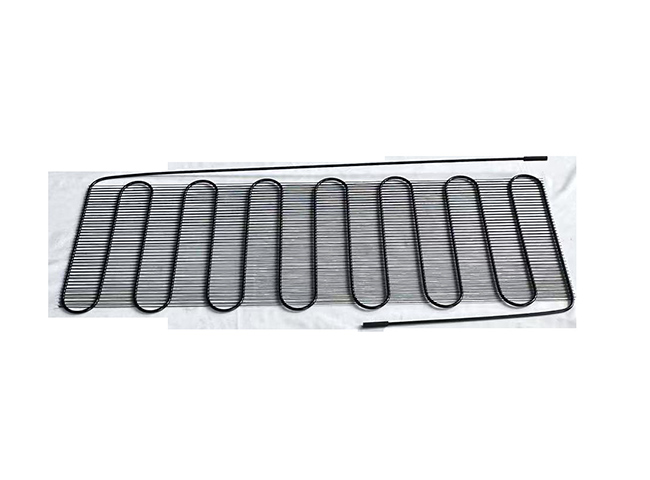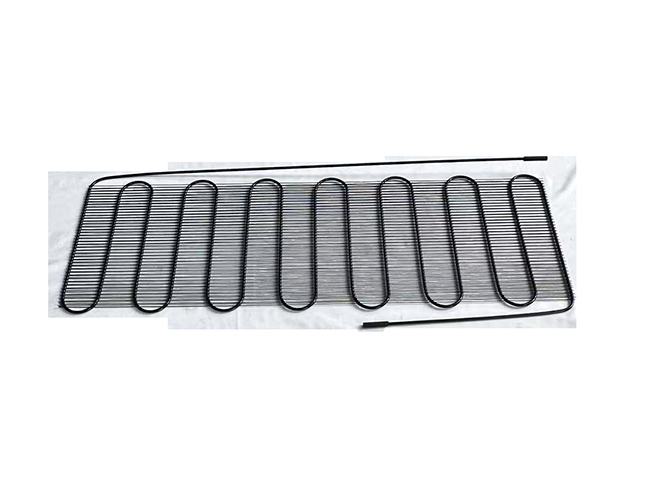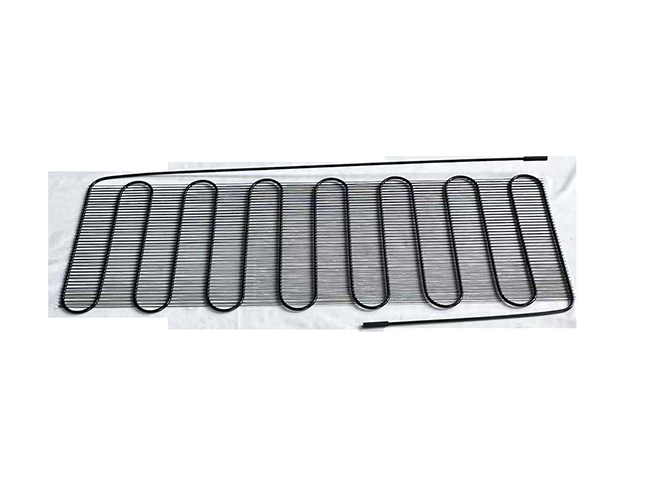
A refrigeration evaporator is one of the most important heat-transfer components in a refrigeration system. It is the point where the refrigerant absorbs heat from a refrigerated space, product, air, water, or industrial process.
For engineers and refrigeration equipment buyers, however, knowing what an evaporator does is only the starting point. The more important questions are:
- How does a refrigeration evaporator actually work?
- What happens to the refrigerant inside the evaporator?
- Which type of evaporator is suitable for a cold room, freezer, display case, or industrial application?
- How should an evaporator be sized?
- How do evaporating temperature, airflow, fin spacing, refrigerant, and heat-transfer area affect performance?
- Why do evaporator coils freeze?
- What information should a buyer provide when requesting a quotation?
- How can you determine whether an evaporator manufacturer can actually provide the right engineering solution?
This guide answers those questions from an engineering and purchasing perspective.
The key point is simple: a refrigeration evaporator is not selected by physical size alone. A properly selected evaporator must match the refrigeration load, refrigerant, evaporating temperature, airflow, installation conditions, defrost strategy, and the rest of the refrigeration system.
Was ist ein Kälteverdampfer?
Refrigeration Evaporator Definition
A refrigeration evaporator is a heat exchanger designed to transfer heat from a cooled medium into the refrigerant.
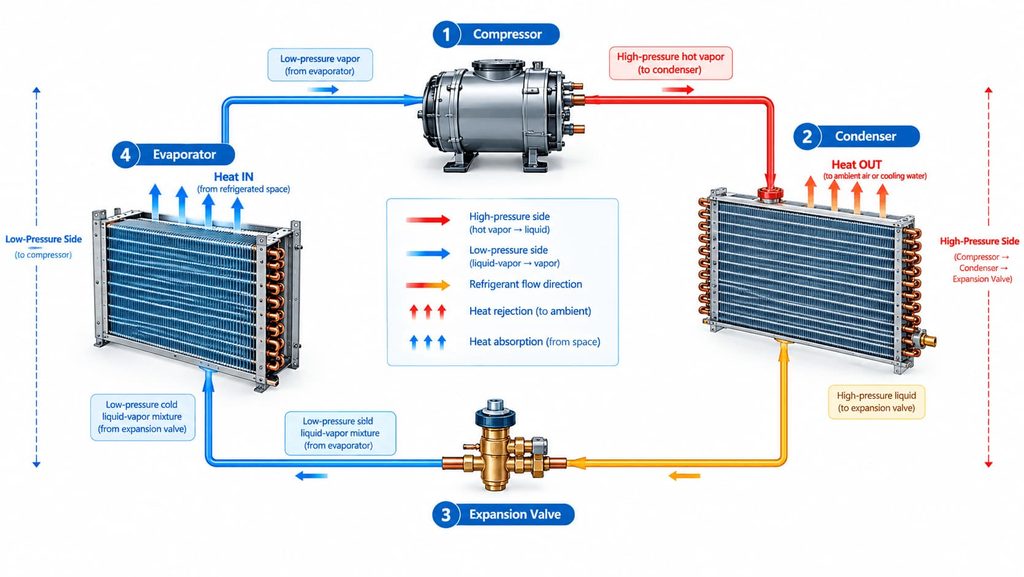
In a typical vapor-compression refrigeration system, the evaporator is located on the low-pressure side of the system, downstream of the expansion device and upstream of the compressor.
The basic process is:
Expansion device → Evaporator → Compressor
After passing through the expansion valve or other expansion device, the refrigerant enters the evaporator at a lower pressure and temperature. Heat from the surrounding air, water, or product is then transferred to the refrigerant. This heat causes the liquid portion of the refrigerant to evaporate.
The evaporator is therefore not simply a “cold coil.” It is a controlled heat exchanger that must achieve the required cooling capacity while maintaining appropriate refrigerant distribution, pressure drop, airflow, and outlet superheat.
What Does an Evaporator Do?
The primary function of a refrigeration evaporator is to absorb heat.
For an air-cooling application, warm air passes over the evaporator surface. Heat moves from the air to the refrigerant inside the tubes. For a liquid-cooling application, such as a chiller, heat can move from water or another fluid into the refrigerant.
The evaporator performs several functions simultaneously:
- Absorbs heat from the cooled medium
- Provides the surface area required for heat transfer
- Allows refrigerant to boil or evaporate
- Controls refrigerant flow through internal circuits
- Helps achieve the required evaporating temperature
- Produces the required cooling capacity
- Delivers refrigerant vapor toward the compressor
Why Is the Evaporator Important?
The evaporator directly determines how effectively the refrigeration system can remove heat from the target application.
An evaporator that is too small may not provide enough heat-transfer area. An evaporator with poor refrigerant distribution may have unused surface area even if its physical dimensions appear sufficient. Excessive frost can reduce airflow and thermal performance. Excessive pressure drop can also change the effective evaporating conditions.
This is why a condenser and evaporator should not be selected independently.
The evaporator, compressor, expansion device, condenser, refrigerant, and operating conditions must work as one system.
Where Is the Evaporator Located?
The physical location depends on the application.
In a household refrigerator, the evaporator is normally located inside or around the freezer/refrigerated compartment.
In a commercial refrigerator or display case, it may be installed behind an internal panel or integrated into a forced-air cooling assembly.
In a cold room, the evaporator is commonly installed inside the refrigerated space as a ceiling-mounted or wall-mounted unit cooler.
In industrial refrigeration, the evaporator may take the form of a finned air cooler, shell-and-tube heat exchanger, plate heat exchanger, flooded evaporator, or another specialized design.
What Is the Function of a Refrigeration Evaporator?
Heat Absorption
The most important function of the evaporator is heat absorption.
The direction of heat transfer is from the warmer medium to the colder refrigerant.
For an air-cooled evaporator:
Room air → Evaporator surface → Refrigerant
For a liquid cooler:
Water/process fluid → Heat exchanger wall → Refrigerant
The refrigerant absorbs this thermal energy and changes phase.
Refrigerant Evaporation
Inside a typical direct-expansion evaporator, refrigerant enters as a low-pressure mixture containing liquid and vapor.
As heat enters the refrigerant, the liquid portion gradually boils.
A simplified process is:
Liquid-rich refrigerant → Two-phase mixture → Mostly vapor → Superheated vapor
The exact internal distribution depends on refrigerant type, circuit design, load, expansion-device control, pressure drop, and evaporator geometry.
Cooling Effect
The cooling effect occurs because the refrigerant absorbs heat while evaporating at a relatively low temperature.
For example, if the refrigerated space is maintained at a temperature above the refrigerant’s evaporating temperature, heat naturally moves toward the colder evaporator surface.
The temperature difference between the cooled medium and refrigerant provides the driving force for heat transfer.
Role in the Refrigeration Cycle
The evaporator completes the low-pressure heat-absorption stage of the vapor-compression cycle.
A simplified cycle is:
- Compressor: compresses low-pressure vapor.
- Condenser: rejects heat and condenses refrigerant.
- Expansion device: reduces refrigerant pressure.
- Evaporator: absorbs heat and evaporates refrigerant.
For this reason, evaporator performance cannot be evaluated separately from the rest of the system.
Wie funktioniert ein Kältemittelverdampfer?
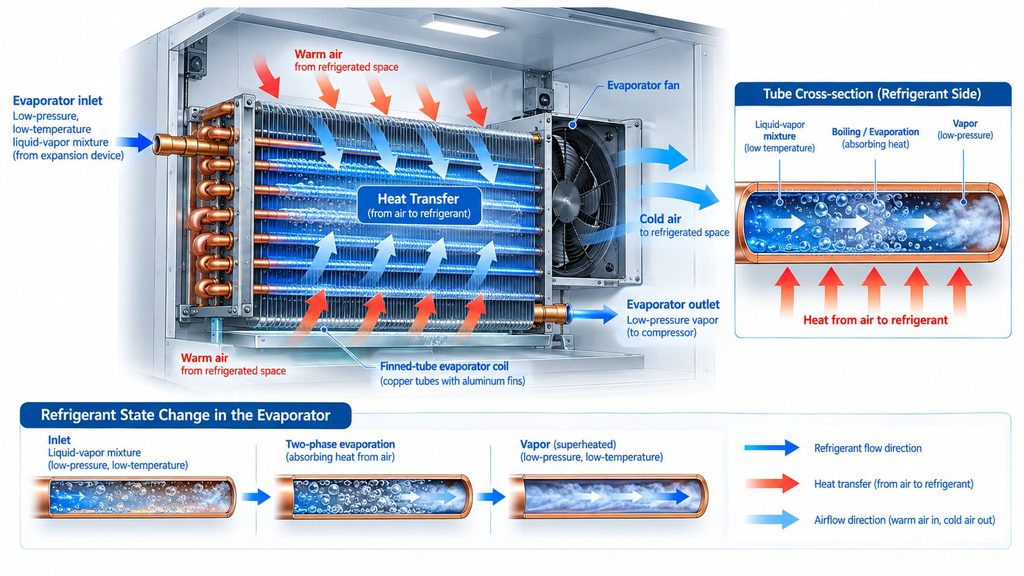
Refrigerant Enters the Evaporator
After the expansion device, the refrigerant pressure drops.
The refrigerant entering the evaporator is typically a low-pressure, low-temperature mixture of liquid and vapor in a direct-expansion system.
The exact inlet condition depends on the refrigerant, expansion device, upstream liquid condition, pressure drop, and system configuration.
Heat Transfer
Heat flows through several layers:
Cooled medium → Air-side or fluid-side boundary layer → Tube wall → Refrigerant-side boundary layer → Refrigerant
This means evaporator performance depends on both external and internal heat-transfer resistance.
For an air-cooled evaporator, important variables include:
- Air temperature
- Luftgeschwindigkeit
- Relative humidity
- Rippenabstand
- Tube geometry
- Refrigerant temperature
- Refrigerant mass flow
- Surface condition
Refrigerant Evaporation
As the refrigerant absorbs heat, the liquid boils.
The two-phase region is particularly important because a large amount of heat can be transferred while the refrigerant changes phase.
The evaporator must be designed so that refrigerant is distributed effectively across its circuits.
Uneven distribution can cause some circuits to become starved while others receive excessive refrigerant.
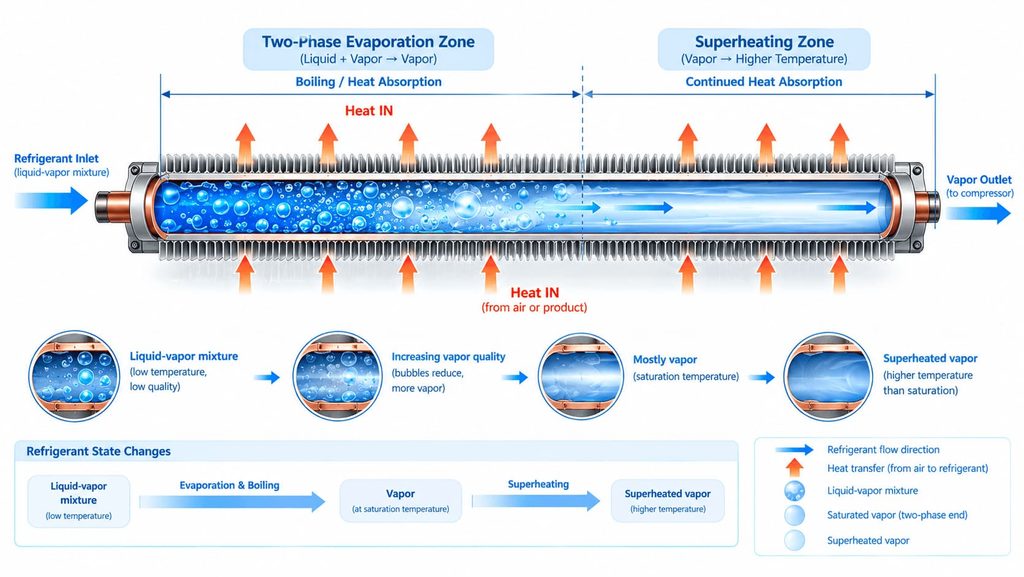
Superheating
After most or all of the liquid refrigerant has evaporated, additional heat raises the vapor temperature above its saturation temperature.
This temperature difference is called superheat.
In simplified terms:
Superheat = Actual refrigerant vapor temperature − Saturation temperature at the measured pressure
Superheat is important because the system generally needs vapor rather than liquid returning to the compressor.
However, more superheat is not automatically better.
Excessive superheat can mean that part of the evaporator is being used primarily to superheat vapor instead of evaporating liquid refrigerant. Excessive superheat reduces evaporator utilization, while insufficient superheat can allow liquid to reach the compressor.
Refrigerant Leaves the Evaporator
The refrigerant exits the evaporator as vapor, normally with a controlled amount of superheat in a dry-expansion system.
The vapor then travels through the suction line to the compressor.
Correct outlet conditions are critical for both evaporator performance and compressor protection.
Refrigeration Evaporator Heat Transfer Process
Two-Phase Evaporation
Two-phase evaporation is the central heat-transfer process in many refrigeration evaporators.
Inside the evaporator, refrigerant may exist simultaneously as liquid and vapor.
As heat is absorbed:
Liquid → Vapor
The proportion of vapor increases along the refrigerant path.
The evaporator therefore does not necessarily operate at one identical refrigerant condition from inlet to outlet.
Saturation Temperature
Saturation temperature is the temperature at which a refrigerant changes phase at a given pressure.
Because refrigeration pressure and saturation temperature are closely related, measuring pressure can help engineers determine the corresponding saturation temperature using appropriate refrigerant property data.
This is why evaporating pressure is an important selection and troubleshooting parameter.
Verdampfungstemperatur
The evaporating temperature must normally be below the temperature of the medium being cooled.
For example, if a cold room must maintain a product or air temperature near a specified target, the evaporating temperature must be selected to provide enough temperature difference for the evaporator to absorb the required heat load.
However, lower evaporating temperature is not automatically better.
A lower evaporating temperature generally increases the temperature lift the compressor must overcome, which can increase energy consumption.
Überhitzung
Superheat is one of the most important operating parameters in a direct-expansion evaporator.
A practical design objective is to use as much evaporator surface as possible while maintaining stable refrigerant control and preventing unwanted liquid carryover.
Optimum superheat depends on evaporator type, load, suction pressure, and operating conditions rather than being one universal fixed value.
Factors Affecting Heat Transfer
Important factors include:
| Factor | Influence on Evaporator Performance |
| Kältemittel | Determines thermodynamic and transport properties |
| Verdampfungstemperatur | Influences temperature difference and compressor lift |
| Wärmeübertragungsfläche | Determines available surface area |
| Rohrdurchmesser | Influences refrigerant velocity and pressure drop |
| Flossen-Design | Influences air-side heat transfer |
| Rippenabstand | Important for airflow and frost resistance |
| Refrigerant circuiting | Controls refrigerant distribution and pressure drop |
| Luftstrom | Influences air-side heat transfer |
| Refrigerant mass flow | Influences refrigerant-side heat transfer |
| Druckabfall | Can affect evaporating conditions |
| Frost accumulation | Can restrict airflow and add thermal resistance |
| Surface cleanliness | Influences heat-transfer performance |
Types of Refrigeration Evaporators
There is no single “best” refrigeration evaporator.
The correct design depends on the application, refrigerant, temperature range, cooling medium, installation space, capacity, defrost requirements, and operating conditions.
Types by Construction
Common designs include:
- Bare tube evaporators
- Finned-tube evaporators
- Plate evaporators
- Shell-and-tube evaporators
- Brazed plate evaporators
- Roll-bond evaporators
- Tube-in-tube evaporators
- Microchannel evaporators
Rippenrohrverdampfer
Finned-tube evaporators are widely used when refrigerant needs to cool air.
Copper or aluminum tubes provide the refrigerant passage while fins increase the external heat-transfer area.
They are commonly found in:
- Kühlräume
- Begehbare Gefrierräume
- Commercial refrigeration
- Display cases
- Air coolers
- HVAC systems
- Industrial air-cooling applications
Plate Evaporator
Plate evaporators provide a compact heat-transfer structure and can be used in applications where space is limited or where direct contact between refrigerant and a plate-based heat-transfer surface is advantageous.
Rohrbündelverdampfer
Shell-and-tube evaporators are commonly used for liquid cooling and industrial applications.
They can be designed for relatively large capacities and are suitable for systems where water or another process fluid is cooled.
Types by Airflow
Air-cooled evaporators can generally be classified by airflow arrangement and fan configuration.
Examples include:
- Forced-air evaporators
- Natural-convection evaporators
- Ceiling-mounted evaporators
- Wall-mounted evaporators
- Static evaporators
Forced-air evaporators use fans to move air across the heat-transfer surface.
Natural-convection designs rely primarily on buoyancy-driven airflow.
Types by Defrosting Method
Low-temperature evaporators may accumulate frost when moisture in the air freezes on the coil surface.
Common defrost approaches include:
- Elektrische Abtauung
- Heißgas-Abtauen
- Abtauung außerhalb des Zyklus
- Wasserabtauen
The correct method depends on operating temperature, humidity, coil geometry, application, and system architecture.
Types by Application Temperature
Evaporators can also be classified according to operating temperature:
- Medium-temperature evaporators
- Low-temperature evaporators
- Freezer evaporators
- Blast-freezing evaporators
- Process-cooling evaporators
The lower the operating temperature, the more important frost management, defrost strategy, airflow, and fin spacing become.
How to Choose Between Different Evaporator Types
A practical selection process should consider:
- Cooling capacity
- Kältemittel
- Verdampfungstemperatur
- Entering and leaving air/fluid temperature
- Airflow or fluid flow
- Available installation space
- Frost conditions
- Defrost method
- Druckabfall
- Material requirements
- Connection requirements
- Required operating pressure
- OEM customization
Refrigeration Evaporator Construction and Components
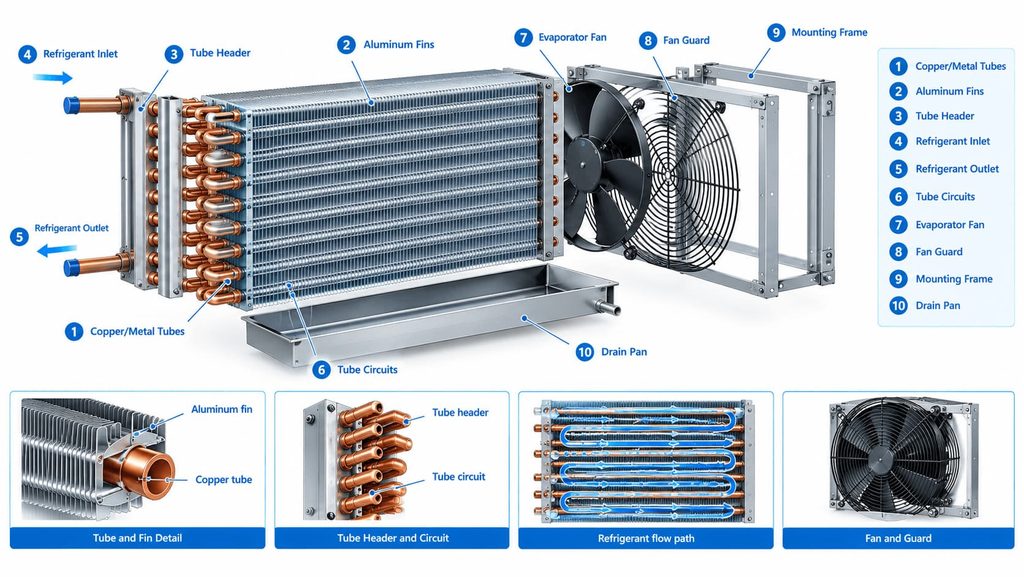
Tubes
Tubes carry the refrigerant through the evaporator.
Common tube materials include copper and aluminum, while specialized systems may use stainless steel or other corrosion-resistant materials.
Tube diameter and wall thickness influence:
- Refrigerant velocity
- Druckabfall
- Mechanical strength
- Refrigerant charge
- Heat-transfer characteristics
Fins
Fins increase the external heat-transfer area.
In an air-cooled evaporator, fin design has a major influence on performance.
Important fin parameters include:
- Fin material
- Fin thickness
- Rippenabstand
- Fin geometry
- Surface treatment
For low-temperature applications, wider fin spacing may be necessary because excessive frost can rapidly restrict airflow.
Headers
Headers distribute refrigerant among parallel circuits.
Poor header design can result in uneven refrigerant distribution, which reduces effective heat-transfer utilization.
Refrigerant Circuits
Circuit design is one of the most important engineering considerations.
An evaporator may contain multiple parallel circuits to control:
- Refrigerant velocity
- Druckabfall
- Heat transfer
- Kältemittelverteilung
- Capacity
Evaporator circuit length is influenced by allowable pressure drop, load per circuit, tube diameter, refrigerant type, overfeed rate, and heat-transfer characteristics.
Pass Configuration
Pass configuration determines how refrigerant travels through the evaporator.
A poorly selected circuit can produce excessive pressure drop or poor refrigerant distribution.
For this reason, circuiting should be designed around actual operating conditions rather than copied from a standard coil dimension.
Fans and Airflow
For forced-air evaporators, fan selection and airflow distribution are part of the heat-exchanger design.
Airflow that is too low can reduce heat transfer.
Airflow that is too high can increase fan power, noise, and potentially undesirable moisture behavior.
Drain Pan
In air-cooled evaporators operating above or near freezing conditions, condensation can form on the coil.
In low-temperature applications, defrost water must also be collected and drained.
Drain-pan geometry, insulation, slope, and drain design therefore matter.
Defrost Components
Low-temperature evaporators may require:
- Heating elements
- Hot-gas circuits
- Drain heaters
- Temperature sensors
- Defrost controls
Defrost design should prevent ice accumulation without unnecessarily increasing energy consumption or product temperature.
Refrigeration Evaporator Design Considerations
Kühlleistung
The first design requirement is cooling capacity.
The evaporator must be able to absorb the required thermal load under the actual operating conditions.
The cooling load may include:
- Product load
- Transmission load
- Air infiltration
- Fan heat
- Lighting
- People
- Motors
- Defrost effects
- Other internal heat sources
For a commercial or industrial application, selecting an evaporator based only on nominal horsepower or physical dimensions is not sufficient.
Kältemittel
Die Wahl des Kältemittels wirkt sich aus auf:
- Saturation temperature
- Druck
- Mass flow
- Heat-transfer characteristics
- Material compatibility
- Valve selection
- Betriebsdruck
- Environmental and regulatory requirements
The evaporator should therefore be designed and selected for the actual refrigerant.
Verdampfungstemperatur
Evaporating temperature determines the temperature difference available for heat transfer.
A very small temperature difference may require a larger heat-transfer surface.
A very low evaporating temperature can increase compressor work.
The objective is not simply to make the evaporator “as cold as possible,” but to meet the application requirement with an appropriate system balance.
Heat Transfer Area
Eine vereinfachte Gleichung für die Wärmeübertragung lautet:
Q = U × A × ΔT
Wo:
- Q = heat-transfer rate
- U = overall heat-transfer coefficient
- A = effektive Wärmeübertragungsfläche
- ΔT = effective temperature difference
In detailed engineering calculations, a log mean temperature difference (LMTD) or another appropriate temperature-difference method may be used.
Tube and Fin Design
Tube diameter, fin pitch, tube spacing, fin material, circuit configuration, and surface treatment all affect evaporator performance.
The design must balance:
Heat transfer + pressure drop + manufacturability + cost + reliability
Increasing heat-transfer area does not automatically produce a proportional improvement because air-side resistance, refrigerant-side resistance, fouling, frost, and pressure drop may become limiting factors.
Refrigerant Circuit
Circuiting must provide good refrigerant distribution while keeping pressure drop within acceptable limits.
For a multi-circuit evaporator, the distributor and circuit lengths are particularly important.
Luftstrom
Airflow must match the heat-transfer design.
For cold-room evaporators, airflow also affects:
- Temperature uniformity
- Product dehydration
- Frost accumulation
- Room air circulation
- Fan power
- Noise
Pressure Drop
Pressure drop must be considered on both refrigerant and air/fluid sides.
Excessive refrigerant pressure drop can reduce effective evaporating pressure and affect compressor operating conditions.
Excessive air-side pressure drop increases fan requirements.
Refrigeration Evaporator Sizing and Design Calculations
Evaporator sizing should be based on operating conditions rather than dimensions alone.
Cooling Load
First determine the required cooling capacity.
A simplified heat-load calculation can be represented as:
Q_load = Q_product + Q_transmission + Q_infiltration + Q_internal
Depending on the application, additional factors may need to be included.
For example, a cold-room calculation may consider:
- Wall/ceiling/floor heat gain
- Product pull-down
- Door opening
- Air infiltration
- Lighting
- Personnel
- Fan motors
- Other equipment
Heat Transfer Area
Once the required duty is known, the required heat-transfer area can be estimated from:
A = Q / (U × ΔT)
This is only a preliminary engineering relationship.
Actual evaporator selection normally requires manufacturer performance data because U depends on construction, refrigerant, airflow, geometry, frost conditions, and operating parameters.
Temperature Difference
For air-cooling applications, a practical selection parameter is the difference between the entering air temperature and the refrigerant evaporating temperature.
A smaller temperature difference generally requires more heat-transfer area for the same capacity.
This creates an important purchasing trade-off:
A larger evaporator can sometimes allow the system to operate with a smaller temperature lift, but the final benefit must be evaluated against equipment cost, size, airflow and system design.
Airflow and Refrigerant Flow
Airflow must be sufficient to transfer the required heat without causing excessive pressure drop.
Refrigerant flow must be sufficient to absorb the required load while maintaining stable refrigerant distribution.
The expansion device must also be matched to the evaporator and operating range.
Pressure Drop
Pressure drop should be checked for:
- Refrigerant circuits
- Distributor
- Headers
- Suction outlet
- Air side
- Water/process-fluid side
Example Calculation
Consider a preliminary air-cooled evaporator design with an estimated refrigeration load of:
Q = 20 kW
Assume an illustrative overall heat-transfer coefficient of:
U = 40 W/m²·K
and an illustrative effective temperature difference of:
ΔT = 10 K
The simplified required area would be:
A = 20,000 / (40 × 10)
A = 50 m²
This is an illustrative engineering calculation, not a universal selection value.
The actual evaporator could require a different effective area because the real U-value depends on tube and fin construction, refrigerant, airflow, frost, surface condition, refrigerant distribution, and operating conditions.
For an actual OEM project, the final selection should therefore be based on tested or manufacturer-rated performance under the specified operating conditions.
So wählen Sie den richtigen Kälteverdampfer aus
A professional evaporator selection should start with the application rather than the physical dimensions.
Anwendung
Identify whether the evaporator will be used for:
- Kühlhaus
- Walk-in cooler
- Walk-in freezer
- Display case
- Commercial refrigerator
- Lebensmittelverarbeitung
- Beverage cooling
- Industrial process cooling
- Kühlaggregat
- HVAC
- OEM refrigeration equipment
Kühlleistung
Provide the required capacity and the conditions under which that capacity must be achieved.
A statement such as “I need a 10 kW evaporator” is incomplete without operating conditions.
Temperatur
Bitte geben Sie Folgendes an:
- Room temperature
- Product temperature
- Lufttemperatur am Einlass
- Desired leaving air temperature
- Verdampfungstemperatur
- Refrigerant saturation condition
Kältemittel
Specify the refrigerant before finalizing the evaporator design.
Luftstrom
For air-cooled evaporators, provide:
- Required airflow
- Fan arrangement
- Available static pressure
- Air temperature
- Humidity
- Air distribution requirements
Fin Spacing
Fin spacing should be selected according to operating temperature and frost conditions.
For applications with significant frost formation, a very tight fin pitch can quickly become restrictive.
Dimensions
Bitte geben Sie Folgendes an:
- Maximale Länge
- Maximale Breite
- Maximale Höhe
- Anschlussort
- Mounting requirements
- Fan location
- Drain location
Material
Material selection depends on:
- Kältemittel
- Air/water/process-fluid conditions
- Corrosion risk
- Operating temperature
- Hygiene requirements
- Expected service life
- Cost target
Defrost Requirements
Specify whether the system requires:
- Elektrische Abtauung
- Heißgas-Abtauen
- Abtauung außerhalb des Zyklus
- Wasserabtauen
Selection Checklist
Before placing an evaporator order, confirm:
| Selection Parameter | Information to Provide |
| Anwendung | Cold room, freezer, chiller, OEM, etc. |
| Capacity | Required refrigeration capacity |
| Kältemittel | Kältemitteltyp |
| Verdampfungstemperatur | Design condition |
| Entering air/fluid temperature | Design condition |
| Leaving air/fluid temperature | Target |
| Airflow/fluid flow | Required flow |
| Rippenabstand | Based on temperature/frost |
| Dimensions | Maximum envelope |
| Connections | Size and location |
| Material | Tube, fin, frame |
| Defrost | Method and requirements |
| Druckabfall | Maximum allowable |
| Working pressure | Design requirement |
| Quantity | Prototype, small batch, mass production |
| Anpassung | OEM/ODM requirements |
How to Choose an Evaporator for Cold Rooms
Food Cold Rooms
Food-storage rooms require careful control of temperature, humidity, airflow, and frost.
The evaporator should be selected according to:
- Product temperature
- Room temperature
- Product load
- Door-opening frequency
- Humidity
- Abtaubedarf
- Air distribution
Industrial Cold Rooms
Industrial cold rooms may have larger cooling loads and more demanding operating cycles.
The evaporator may require:
- Higher airflow
- Multiple fans
- Larger heat-transfer area
- Specialized defrost
- Corrosion-resistant materials
- Custom mounting
Frozen Storage
Frozen-storage applications normally operate at lower temperatures and are more sensitive to frost.
The design should therefore consider:
- Rippenabstand
- Defrost frequency
- Drain heating
- Fan operation
- Frost accumulation
- Product dehydration
- Air distribution
Defrost and Frost Considerations
Frost acts as an additional thermal resistance and can also restrict airflow.
As frost accumulates:
Airflow ↓ → Heat transfer ↓ → Cooling capacity ↓
The evaporator may then require more operating time to achieve the same room temperature.
Proper defrost design is therefore part of evaporator selection, not merely a maintenance issue.
Refrigeration Evaporator Applications
Cold Storage
Evaporators are used to maintain controlled temperatures in:
- Cold warehouses
- Food storage rooms
- Frozen storage
- Distribution centers
Gewerbliche Kältetechnik
Zu den Anwendungsbereichen gehören:
- Supermarket refrigeration
- Kühlvitrinen
- Display cases
- Beverage coolers
- Gewerbliche Gefrierschränke
Display Cases
Display-case evaporators require compact geometry, suitable airflow, low noise, and appropriate temperature control.
Food Processing
Food-processing applications can have highly variable loads.
For example, a process may start with a high product temperature and transition to a lower holding load.
We provide an example of a food-process cooling application in which the cooling load changes from 100 kW during initial cooling to 20 kW at the holding stage, illustrating why evaporator and refrigerant-control performance must be considered across the entire load range rather than at only one design point.
Beverage Cooling
Evaporators can cool water, glycol, beverages, and other process fluids.
Industrial Process Cooling
Industrial applications may require customized evaporators for:
- Process water
- Glycol
- Brine
- Lebensmittelverarbeitung
- Chemical processes
- Industriekühlanlagen
Refrigeration Evaporator Temperature
Verdampfungstemperatur
Evaporating temperature is closely related to evaporating pressure.
The correct value depends on the required cooled-medium temperature and the heat-transfer approach.
A lower evaporating temperature can increase the temperature difference, but it may also increase compressor work.
Daher:
The lowest possible evaporating temperature is not necessarily the most energy-efficient design.
Evaporator Coil Temperature
The actual coil surface temperature depends on the refrigerant condition, pressure, heat load, airflow, and heat-transfer resistance.
It should not be assumed that the entire coil is at exactly one temperature.
Frost vs Ice
Frost consists of deposited ice crystals and can gradually accumulate on the evaporator surface.
Heavy frost is different from normal condensation.
In low-temperature refrigeration, frost accumulation can:
- Reduce airflow
- Increase thermal resistance
- Reduce cooling capacity
- Increase fan load
- Increase defrost frequency
Temperature and Energy Efficiency
Evaporating temperature is one of the important variables affecting system energy consumption.
In refrigeration applications, each 1 K increase in evaporating temperature has the potential to produce approximately 2–3% energy savings, depending on system conditions. This should be treated as an engineering guideline rather than a universal guaranteed saving for every system.
This illustrates why evaporator selection is connected directly to energy efficiency.
A well-designed evaporator can help provide adequate heat transfer without requiring unnecessarily low evaporating temperatures.
Common Refrigeration Evaporator Problems and Troubleshooting
Evaporator Coil Freezing
Mögliche Ursachen sind unter anderem:
- Low airflow
- Dirty coil
- Falsche Kältemittelfüllmenge
- Expansion-device problems
- Low load
- Incorrect evaporating temperature
- Defrost failure
Do not assume that every frozen coil means “too much refrigerant.”
The complete system should be diagnosed.
Poor Cooling
Mögliche Ursachen sind unter anderem:
- Insufficient evaporator capacity
- Low airflow
- Frost accumulation
- Incorrect refrigerant feed
- Dirty coil
- Incorrect evaporating temperature
- Compressor or condenser problems
- Incorrect expansion-device selection
Refrigerant Leakage
Leakage may occur at:
- Tube joints
- Brazed connections
- Headers
- Mechanical connections
- Corroded tube sections
Leak detection should be performed using appropriate procedures and equipment.
Dirty or Clogged Coil
Dirt reduces airflow and increases air-side thermal resistance.
For air-cooled evaporators, the coil should be inspected according to operating environment.
Uneven Frost
Uneven frost can be an important diagnostic clue.
Potential causes include:
- Uneven refrigerant distribution
- Starved circuit
- Expansion-device problem
- Refrigerant restriction
- Airflow imbalance
- Incorrect charge
- Circuiting issue
Evaporator Failure
A complete evaporator failure can result from:
- Severe corrosion
- Refrigerant leakage
- Mechanical damage
- Tube failure
- Header damage
- Repeated freezing/defrost stress
Repair vs Replacement
Repair may be appropriate when:
- Damage is localized
- Tube access is possible
- Material condition is good
- Pressure testing can confirm integrity
Replacement may be more appropriate when:
- Corrosion is widespread
- Multiple leaks exist
- The coil is undersized
- Replacement parts are obsolete
- The existing design has poor performance
- The application has changed
Refrigeration Evaporator Maintenance and Cleaning
Cleaning
A dirty evaporator should be cleaned using a method compatible with the coil material and application.
Avoid aggressive cleaning that can damage fins or protective coatings.
Airflow Inspection
Check:
- Fan operation
- Fan rotation
- Blocked airflow
- Damaged fins
- Dirty coil
- Air distribution
Frost Inspection
Inspect:
- Frost thickness
- Frost distribution
- Defrost frequency
- Defrost completion
- Drain condition
Leak Inspection
Look for:
- Oil stains
- Korrosion
- Damaged joints
- Pressure loss
- Abnormal refrigerant behavior
Defrost Maintenance
Check:
- Defrost heater
- Hot-gas circuit where applicable
- Defrost sensor
- Timer/controller
- Drain heater
- Drain line
The U.S. Department of Energy has highlighted the importance of defrost-related efficiency in refrigeration, noting that conventional electric defrost introduces additional heat that the refrigeration system must subsequently remove.
Refrigeration Evaporator and Energy Efficiency
Heat Transfer
A larger heat-transfer area is not automatically the best solution.
The objective is to optimize:
Capacity + temperature difference + airflow + pressure drop + refrigerant distribution
Frost and Ice
Frost increases thermal resistance and can restrict airflow.
This is particularly important in freezer and low-temperature applications.
Luftstrom
Airflow affects both heat transfer and fan energy.
Excessive airflow can increase fan power without providing proportional cooling benefits.
Insufficient airflow can reduce capacity and create temperature non-uniformity.
Verdampfungstemperatur
Raising evaporating temperature where application conditions allow can reduce compressor temperature lift.
Superheat control and evaporator utilization are closely linked; excessive superheat can leave part of the evaporator surface underutilized, while insufficient superheat can create liquid-return risks.
Proper Sizing
An oversized or undersized evaporator can both create system-level problems.
Undersized evaporator:
- Insufficient capacity
- Low evaporating temperature
- Longer compressor runtime
- Potentially higher energy consumption
Oversized evaporator:
- Higher initial cost
- Larger installation space
- Potential control challenges
- Potential mismatch with compressor and expansion device
The correct target is not “largest possible.”
It is properly matched capacity under the actual design conditions.
Refrigeration Evaporator vs Condenser
The evaporator and condenser perform opposite heat-transfer functions.
| Parameter | Verdampfer | Kondensator |
| Hauptfunktion | Nimmt Wärme auf | Leitet Wärme ab |
| System side | Low-pressure side | High-pressure side |
| Refrigerant process | Evaporates | Condenses |
| Typical inlet | Niederdruck-Flüssigkeits-Dampf-Gemisch | High-pressure superheated vapor |
| Typical outlet | Vapor with controlled superheat | High-pressure liquid, often subcooled |
| Heat direction | Into refrigerant | Out of refrigerant |
| Main application role | Produces cooling effect | Removes system heat |
| Typischer Standort | Refrigerated space or heat source | Ambient/cooling-water side |
For a complete comparison, see:
Custom Refrigeration Evaporator for OEM Applications
Standard evaporator dimensions do not always fit OEM equipment.
Custom refrigeration evaporators may be required when the buyer has specific:
- Cabinet dimensions
- Cooling capacity
- Kältemittel
- Connection positions
- Fan arrangement
- Mounting points
- Rippenabstand
- Material requirements
- Defrost method
- Pressure-drop limits
Custom Dimensions
An OEM evaporator may need to fit a fixed equipment envelope.
Zum Beispiel:
Maximum evaporator envelope:
- Length: specified by cabinet
- Width: specified by available airflow space
- Height: limited by installation area
The coil should be designed around the available space rather than simply reducing an existing standard model.
Custom Capacity
Capacity should be specified together with operating conditions.
A useful OEM RFQ should include:
Required capacity + refrigerant + evaporating temperature + entering air/fluid temperature + airflow/fluid flow
Without these conditions, a quoted capacity may not be directly comparable between suppliers.
Refrigerant Compatibility
The manufacturer should confirm compatibility between the evaporator design and the intended refrigerant and pressure range.
Circuit Design
OEM evaporators may require custom:
- Circuit numbers
- Circuit lengths
- Headers
- Distributors
- Tube diameters
- Connection positions
OEM / ODM
For OEM/ODM projects, the supplier should be able to support:
- Technical drawing review
- Performance calculation
- Prototype development
- Sample testing
- Design modification
- Production tooling where required
- Mass production
- Quality inspection
- Packaging
- Technical documentation
How to Choose a Refrigeration Evaporator Manufacturer
Choosing an evaporator manufacturer should involve more than comparing unit prices.
Manufacturing Capability
Ask whether the manufacturer can produce the required:
- Rohrdurchmesser
- Flossenabstand
- Abmessungen der Spule
- Schaltungskonfiguration
- Headers
- Materials
- Connection types
- Defrost configuration
Qualitätskontrolle
Ask about inspection procedures for:
- Tube dimensions
- Fin assembly
- Brazing
- Welding
- Circuit integrity
- Surface condition
- Dimensional accuracy
Testing
Important tests may include:
- Druckprüfung
- Dichtheitsprüfung
- Vacuum/holding checks
- Maßprüfung
- Performance testing where available
For custom OEM projects, performance testing under specified conditions is especially valuable because it provides a more meaningful basis for comparison than physical dimensions alone.
Anpassung
A capable supplier should be able to review a technical drawing or operating-condition sheet and identify whether the proposed evaporator is actually suitable.
Production Capacity
For distributors and OEM customers, also evaluate:
- Monthly production capacity
- Lead time
- Sample lead time
- Production consistency
- Packaging
- Export experience
- Documentation
- After-sales technical support
What Data Should You Send to an Evaporator Manufacturer?
For a serious quotation, provide as much of the following information as possible:
Anwendung
Cold room, freezer, display case, chiller, OEM cabinet, industrial process, etc.
Kältemittel
Specify the refrigerant.
Required Capacity
Provide the required cooling capacity and capacity test condition.
Betriebstemperatur
Bitte geben Sie Folgendes an:
- Room temperature
- Lufttemperatur am Einlass
- Ausgangslufttemperatur
- Verdampfungstemperatur
- Expected ambient conditions
Air or Fluid Flow
For air-cooled systems:
- Luftstrom
- Fan configuration
- Static pressure
For liquid applications:
- Fluid type
- Flow rate
- Entering temperature
- Leaving temperature
Mechanical Requirements
Bitte geben Sie Folgendes an:
- Length
- Width
- Height
- Mounting position
- Anschlussgröße
- Anschlussort
- Drain location
Defrost
Specify the required defrost method and heater requirements if applicable.
Quantity
State whether the project is:
- Prototype
- Sample
- Small batch
- Regular production
- Large OEM program
The more complete the technical information, the more meaningful the supplier quotation becomes.
Refrigeration Evaporator Buying Checklist
Before selecting a supplier, review the following:
Technical
- Refrigerant confirmed
- Cooling capacity confirmed
- Evaporating temperature confirmed
- Entering/leaving temperature confirmed
- Airflow or fluid flow confirmed
- Pressure drop reviewed
- Fin spacing selected
- Circuit design reviewed
- Material confirmed
- Working pressure confirmed
- Defrost method confirmed
Mechanical
- Overall dimensions confirmed
- Mounting points confirmed
- Refrigerant connections confirmed
- Drain position confirmed
- Fan position confirmed
- Installation clearance confirmed
Quality
- Leak test
- Pressure test
- Maßprüfung
- Brazing/welding inspection
- Sample approval
- Performance verification where required
Commercial
- MOQ
- Sample cost
- Production lead time
- Packaging
- Shipping requirements
- Documentation
- Warranty terms
- OEM customization capability
Before sending an RFQ, prepare the following information:
| Category | Buyer Information |
| Anwendung | Cold room / freezer / display case / industrial |
| Cooling capacity | ___ kW |
| Kältemittel | ___ |
| Room temperature | ___ °C |
| Verdampfungstemperatur | ___ °C |
| Ambient temperature | ___ °C |
| Dimensions | ___ × ___ × ___ mm |
| Luftstrom | ___ m³/h |
| Rippenabstand | ___ mm |
| Defrost | Air / electric / hot gas |
| Tube material | ___ |
| Fin material | ___ |
| Anschlussgröße | ___ |
| Quantity | ___ pcs |
| OEM requirement | Yes / No |
| Required delivery | ___ |
If some values are unknown, provide the application and target temperatures first. A technically capable evaporator manufacturer should be able to identify which additional parameters are needed for final selection.
Frequently Asked Questions About Refrigeration Evaporators
What does an evaporator do?
A refrigeration evaporator absorbs heat from air, water, or another cooled medium and transfers that heat to the refrigerant. The refrigerant uses the absorbed heat to evaporate.
How does a refrigeration evaporator work?
Low-pressure refrigerant enters the evaporator and absorbs heat from the surrounding medium. The refrigerant evaporates as it absorbs heat and normally leaves as vapor with controlled superheat in a dry-expansion system.
What happens to refrigerant in an evaporator?
The refrigerant changes from a liquid-rich or two-phase condition toward vapor as it absorbs heat. Additional heat after complete evaporation can produce superheated vapor.
What state does refrigerant enter the evaporator in?
The exact state depends on the system and expansion arrangement. In many direct-expansion systems, refrigerant enters as a low-pressure two-phase mixture.
What state does refrigerant leave the evaporator in?
In a properly controlled direct-expansion system, refrigerant normally leaves as superheated vapor.
Why does an evaporator freeze?
Common causes include insufficient airflow, low evaporating temperature, incorrect refrigerant feed, dirty coils, defrost problems, or operating conditions that produce excessive frost.
Should an evaporator coil have frost?
It depends on the application and operating condition. Some frost can occur in low-temperature systems, but excessive frost can restrict airflow and reduce heat-transfer performance.
How do you select an evaporator?
Start with the required cooling capacity and operating conditions. Then match the refrigerant, evaporating temperature, airflow, fin spacing, heat-transfer area, dimensions, pressure drop, material, and defrost method.
How do I size a refrigeration evaporator?
Determine the actual heat load first, then select an evaporator that provides the required capacity under the specified refrigerant and operating conditions. Heat-transfer area, TD, airflow, refrigerant flow, pressure drop, and frost conditions must all be considered
How often should an evaporator be cleaned?
There is no universal cleaning interval. The correct interval depends on air quality, humidity, application, operating temperature, dust load, and frost conditions.
Regular inspection is more useful than relying on a fixed calendar interval.
Can an evaporator be customized?
Yes. OEM refrigeration evaporators can be customized for dimensions, capacity, refrigerant, tube and fin configuration, circuiting, connections, airflow, materials, and defrost requirements.
Conclusion: Select the Evaporator as Part of the System, Not as an Isolated Component
A refrigeration evaporator is much more than a coil.
It is the heat-transfer interface between the refrigeration system and the application being cooled.
Its performance depends on the interaction between:
Cooling Load + Refrigerant + Evaporating Temperature + Heat-Transfer Area + Airflow + Circuiting + Pressure Drop + Frost/Defrost + System Matching
For a standard replacement project, selecting an evaporator based on the original model and operating conditions may be sufficient.
For a new refrigeration system or OEM project, however, the selection process should start with the actual application and required cooling duty.
A technically appropriate evaporator can help provide:
- stable cooling performance
- appropriate temperature control
- efficient heat transfer
- manageable frost accumulation
- suitable humidity conditions
- reliable long-term operation
Looking for a Refrigeration Evaporator for Your Application?
If you are sourcing a refrigeration evaporator, evaporator coil, air cooler evaporator, or a custom OEM evaporator, provide your application requirements, cooling capacity, refrigerant, operating temperatures, dimensions, airflow, and quantity.
A qualified evaporator manufacturer can then evaluate the required configuration and provide a technical quotation based on the actual operating conditions.