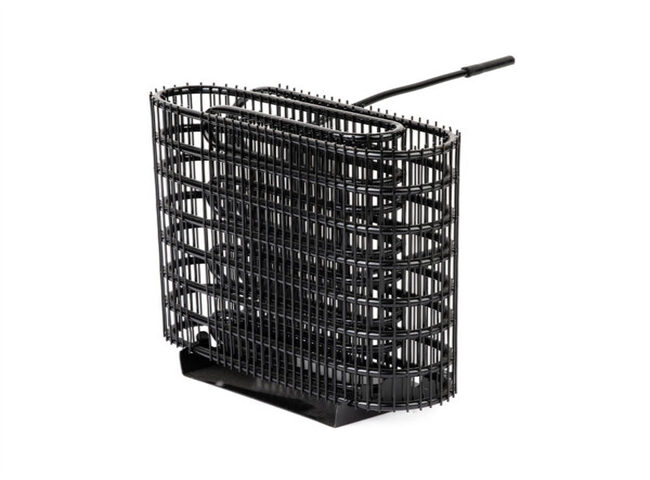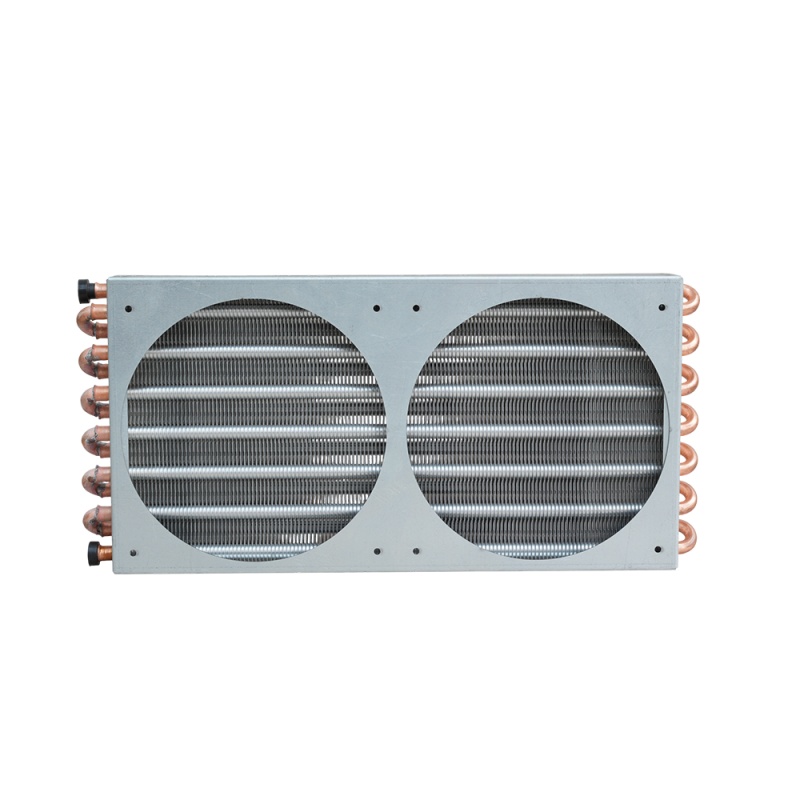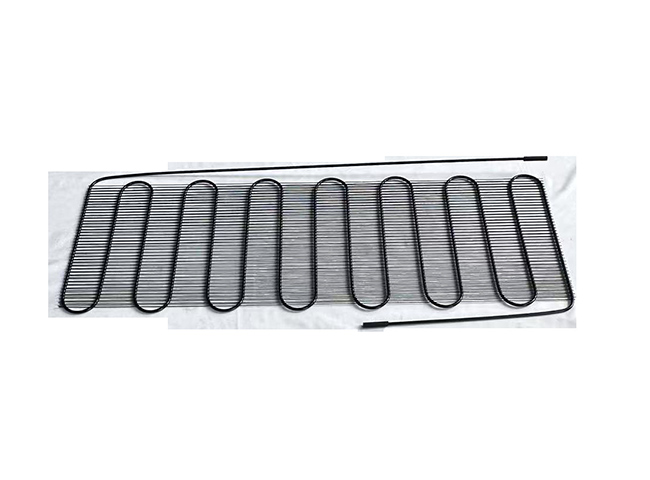
Introduction: Which Condenser Is the Better Choice for Industrial Refrigeration?
Choosing between an evaporative condenser and an air-cooled condenser is not simply a question of which equipment has the higher rated capacity or lower purchase price. The decision affects compressor power consumption, water use, maintenance workload, installation requirements, and the long-term operating cost of an industrial refrigeration plant.
The fundamental difference is how each system rejects heat.
An air-cooled condenser transfers heat from refrigerant to ambient air through a finned-tube heat exchanger. Its heat-rejection performance is strongly influenced by the outdoor dry-bulb temperature.
An evaporative condenser combines air and water to reject heat. Refrigerant condenses inside a coil while recirculating spray water wets the outside of the coil. Airflow promotes the evaporation of a portion of this water, removing heat from the refrigerant. Its thermal performance is therefore closely related to the entering-air wet-bulb temperature.
This difference can create an important operating advantage. Under suitable climate and load conditions, an evaporative condenser can operate at a lower condensing temperature than an air-cooled condenser. A lower condensing temperature may reduce compressor power consumption. However, the evaporative system also introduces water consumption, water treatment, additional components, and specific maintenance requirements.
Neither option is automatically better for every facility.
For a plant operating long hours in a hot, dry climate with reliable water supply, an evaporative condenser may offer an attractive energy-cost advantage. For a facility in a water-scarce area, a site with strict wastewater restrictions, or a smaller installation with limited maintenance resources, an air-cooled condenser may be the more practical choice.
This guide compares the two technologies from an industrial refrigeration engineering and purchasing perspective. It explains how they work, how climate affects performance, how to estimate water and energy costs, and what information engineers should confirm before requesting a condenser quotation.
The key selection principle is simple: compare the complete refrigeration system under the site’s actual design conditions—not just the condenser’s purchase price or nominal efficiency.
1. What Is an Evaporative Condenser?
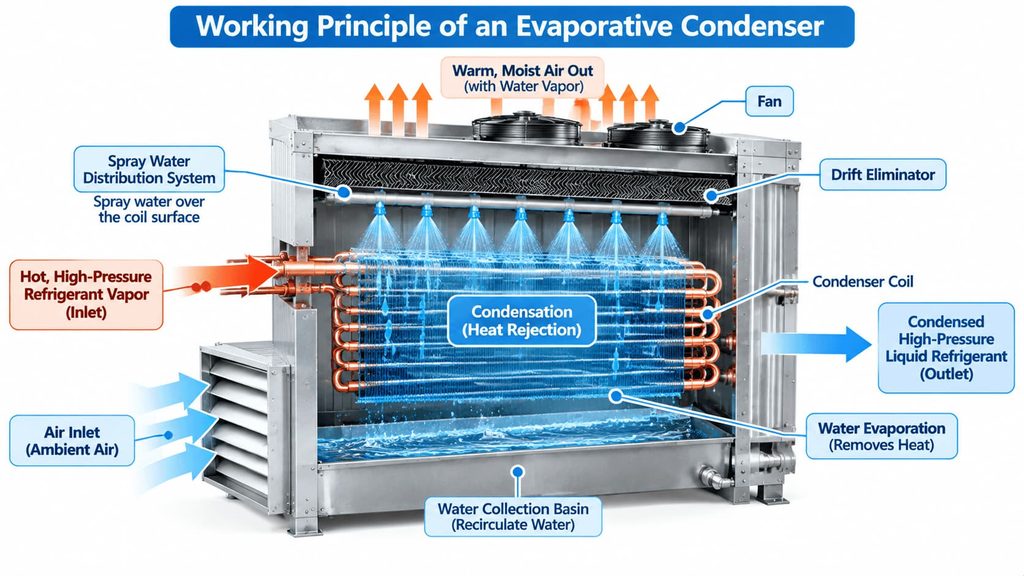
An evaporative condenser is a heat-rejection device that uses both air and water to condense refrigerant vapor.
Unlike a conventional water-cooled condenser, which transfers heat from refrigerant to a separate circulating water stream, an evaporative condenser has refrigerant flowing directly through its condensing coil. Spray water is distributed over the outside of the coil, while air passes through the equipment. A portion of the water evaporates and carries heat away.
This arrangement combines refrigerant condensation and evaporative heat rejection in one piece of equipment. It does not normally require the same separate refrigerant condenser and cooling-tower arrangement used in a conventional water-cooled system.
An evaporative condenser is one of several condenser technologies used in refrigeration systems. To understand the broader role of this equipment, including its main types, heat-transfer principles and design considerations, see our guide to refrigeration condenser types and design principles.
Main Components of an Evaporative Condenser
An industrial evaporative condenser typically includes the following components.
Refrigerant Condensing Coil
The condensing coil contains the high-pressure refrigerant vapor discharged from the compressor. Heat passes through the coil wall to the water film and surrounding air.
The coil is commonly constructed from steel tubing or other materials selected according to refrigerant compatibility, pressure requirements, and corrosion conditions. Coil design, tube arrangement, surface area, and material protection all influence thermal performance and service life.
For industrial applications, the coil must be selected for the actual refrigerant, design pressure, heat-rejection capacity, and operating conditions. A unit’s physical dimensions alone do not establish whether it is suitable for a particular refrigeration system.
Spray Water Distribution System
A pump delivers recirculating water to a distribution header. Spray nozzles distribute the water over the external surface of the condensing coil.
Uniform wetting is important. If some coil sections receive insufficient water, local heat-transfer performance may deteriorate. Blocked nozzles, uneven water distribution and mineral deposits can create dry areas or reduce the effectiveness of the wetted surface.
Circulating Water Pump and Sump
Water that does not evaporate falls into a collection basin or sump and is recirculated by the pump.
The sump also provides a location for water-level control, makeup-water supply, and blowdown. Its design should allow inspection and cleaning because suspended solids and accumulated deposits can affect water quality and system reliability.
Fans and Airflow System
Fans move air through the equipment and across the wetted coil. The airflow supports evaporation and carries rejected heat and water vapor away from the unit.
Fan selection, air velocity, discharge arrangement, and equipment location all affect performance. Poor installation can allow warm, humid discharge air to return to the air inlet, reducing the effective cooling potential.
Drift Eliminators and Water Makeup System
Drift eliminators reduce the amount of liquid water droplets carried out of the equipment with the discharge air. They do not eliminate all water loss, but properly selected and maintained eliminators help control it.
A makeup-water system replaces water lost through evaporation, drift, and blowdown. Water-level controls and appropriate treatment arrangements help maintain stable operation.
How Does an Evaporative Condenser Work?
The operating process can be understood in five stages.
Hot Refrigerant Vapor Enters the Condensing Coil
The compressor delivers high-pressure, high-temperature refrigerant vapor to the condenser. The refrigerant enters the coil and begins releasing heat.
Spray Water Is Distributed Over the Coil Surface
The spray system wets the outside of the coil. Water forms a film over the heat-transfer surface, creating the conditions required for evaporative heat rejection.
Airflow Promotes Water Evaporation
Fans move air across the wetted coil. A portion of the circulating water evaporates into the airstream.
Evaporation requires energy. That energy is drawn from the heat being rejected by the refrigerant, cooling the coil and allowing refrigerant condensation to proceed.
Heat Is Rejected as Refrigerant Condenses
As the refrigerant releases heat, its vapor condenses into liquid inside the coil. The process involves both sensible cooling of the hot vapor and latent heat removal during condensation.
Liquid Refrigerant Leaves the Condenser
The condensed refrigerant leaves the condenser as liquid and continues toward the receiver or the next component in the refrigeration circuit, depending on system configuration.
Common Types of Evaporative Condensers
Evaporative condensers can be classified by fan arrangement and airflow direction.
Induced-Draft Evaporative Condensers
In an induced-draft arrangement, fans are generally positioned near the air discharge side and draw air through the equipment.
This configuration can help provide a controlled airflow path and discharge warm, moisture-laden air above the unit. The installation must still provide adequate clearance to avoid discharge-air recirculation.
Forced-Draft Evaporative Condensers
Forced-draft designs use fans to push air into or through the equipment. The fan arrangement can influence maintenance access, airflow distribution and equipment layout.
The suitability of forced- or induced-draft equipment depends on the manufacturer’s design, available space, noise requirements, and site conditions. One arrangement should not be assumed to be universally more efficient.
Crossflow and Counterflow Configurations
Crossflow and counterflow describe the relative directions of air and water movement.
In a crossflow arrangement, air and water move across the heat-transfer section in generally perpendicular directions. In a counterflow arrangement, their overall directions oppose one another.
The appropriate configuration depends on equipment design, heat-transfer requirements, water distribution, airflow resistance, and maintenance considerations.
2. What Is an Air-Cooled Condenser?

An air-cooled condenser rejects heat directly to ambient air through a finned-tube heat exchanger.
High-pressure refrigerant vapor flows inside the tubes. Fans move outdoor air across the external fin surfaces, allowing heat to transfer from the refrigerant to the surrounding air. As the refrigerant loses heat, it condenses into liquid.
An air-cooled condenser does not require a circulating spray-water system for its normal heat-rejection process. This makes it attractive for sites where water availability, water treatment or wastewater management is a concern.
However, it is not maintenance-free. Coil cleanliness, fan operation, airflow clearance, and condensing-pressure control remain important.
Main Components of an Air-Cooled Condenser
Finned-Tube Heat Exchanger Coil
The coil normally consists of refrigerant tubes with external fins. The fins increase the heat-transfer surface exposed to air.
Tube material, fin material, fin spacing, tube arrangement, and surface treatment should be selected according to the refrigerant, operating pressure, and environmental conditions.
Fin spacing is particularly relevant in dusty or contaminated environments. A tightly spaced coil may offer a large heat-transfer surface, but it can be more difficult to clean if the site contains airborne dust, fibers, or other deposits.
Axial Fans
Axial fans move ambient air through the finned coil. Their airflow rate and operating characteristics influence the condenser’s ability to reject heat.
Fan performance should be evaluated together with coil resistance, installation clearance, and the expected ambient temperature.
Fan Motors and Capacity Controls
Fan motors drive the airflow system. Depending on the equipment design, capacity control may include staged fan operation, variable-speed drives or other control arrangements.
Good control allows the condenser to respond to changing ambient conditions and refrigeration loads. Operating every fan at full speed under all conditions is not necessarily the most economical strategy.
Refrigerant Inlet and Liquid Outlet Connections
The inlet connection receives hot, high-pressure refrigerant vapor from the compressor. The outlet connection delivers condensed liquid refrigerant to the next part of the system.
Connection size, pressure rating, refrigerant compatibility, and installation orientation should be confirmed during equipment selection.
How Does an Air-Cooled Condenser Work?
High-Pressure Refrigerant Vapor Enters the Coil
The compressor discharge enters the condenser coil. The refrigerant is hotter than the surrounding air and begins transferring heat through the tube wall.
Ambient Air Passes Across the Finned Tubes
Fans draw or push outdoor air across the finned surface. The fins increase the area available for heat transfer.
Heat Transfers from Refrigerant to Air
Heat moves from the refrigerant to the tube wall, then through the fins and into the passing air. The air temperature rises as it absorbs heat.
Refrigerant Condenses and Leaves as Liquid
As sufficient heat is removed, the refrigerant vapor condenses. The liquid refrigerant then leaves the condenser and continues through the refrigeration system.
Common Air-Cooled Condenser Configurations
Horizontal Airflow Design
In a horizontal airflow arrangement, air moves through the coil horizontally. The layout may be suitable for installations where the available space and discharge-air direction support this configuration.
Vertical Discharge Design
Vertical-discharge equipment generally moves air through the coil and releases heated air upward. Adequate overhead clearance is important to reduce the risk of discharge-air recirculation.
V-Shaped Condenser Design
A V-shaped coil arrangement provides a larger heat-transfer surface within a relatively compact footprint. It is used in some higher-capacity equipment designs.
The actual space requirement depends on the complete unit, including fan arrangement, service access, airflow clearance and piping connections—not only the coil dimensions.
3. Evaporative Condenser vs. Air-Cooled Condenser: Key Differences

The most important difference is the cooling medium and the temperature that limits heat rejection.
An air-cooled condenser relies on ambient dry-bulb temperature. An evaporative condenser uses the combined effects of air and water evaporation, so entering-air wet-bulb temperature is a key rating condition.
This distinction affects condensing temperature, compressor operation, water use, and equipment selection.
Key Comparison Table
| Comparison factor | Evaporative condenser | Air-cooled condenser |
|---|---|---|
| Heat-rejection medium | Air and recirculating spray water | Ambient air |
| Refrigerant location | Inside the condensing coil | Inside the finned-tube coil |
| Main temperature reference | Entering-air wet-bulb temperature | Entering-air dry-bulb temperature |
| Water requirement | Requires makeup water | No process spray water required |
| Water treatment | Required according to water quality and operating conditions | No condenser spray-water treatment |
| Condensing temperature | Can be lower under suitable conditions | Strongly influenced by ambient dry-bulb temperature |
| Compressor energy | May be lower when lower condensing conditions are achieved | May increase during high ambient-temperature operation |
| Auxiliary electricity | Fans and circulating-water pump | Fans |
| Maintenance focus | Coil, spray system, sump, water quality, drift eliminators and fans | Fins, coil, fans, motors and airflow |
| Installation considerations | Water supply, drainage, structural support and airflow | Airflow clearance, structural support and service access |
| Typical selection priority | Long operating hours, suitable wet-bulb conditions and reliable water supply | Water conservation, simpler utilities and lower water-management requirements |
The table provides a preliminary comparison. Actual performance must be checked against equipment ratings at the same refrigerant, heat-rejection duty and design conditions.
Heat Rejection and Cooling Principles
Both condenser types perform the same basic function: removing heat from refrigerant so that it can condense.
However, the heat-transfer paths are different.
In an air-cooled condenser:
Refrigerant → tube wall and fins → ambient air
In an evaporative condenser:
Refrigerant → condensing coil → water film and air → outdoor environment
The second arrangement uses water evaporation to increase the heat-rejection potential. It is not simply an air-cooled condenser with water sprayed onto it, nor is it identical to a conventional water-cooled condenser connected to a separate cooling tower.
In a conventional water-cooled arrangement, refrigerant transfers heat to water inside a condenser heat exchanger. That water may then circulate to a separate cooling tower. In an evaporative condenser, refrigerant condenses directly inside the wetted coil while water evaporates on the outside.
This distinction matters when comparing equipment cost, system layout, water circulation, maintenance, and total energy use.
It is also important to distinguish evaporative condensers from conventional water-cooled condensers. Although both involve water-based heat rejection, their refrigerant-side and water-side arrangements are different. If you are comparing these broader system configurations, see our article on air-cooled and water-cooled condenser differences
Regardless of the condenser type, its primary function is to remove heat from the refrigerant so that the vapor can condense into liquid. For a closer look at the heat-rejection process, including the refrigerant’s desuperheating, condensation, and subcooling stages, read our guide to how a condenser rejects heat in a refrigeration system.
Dry-Bulb vs. Wet-Bulb Temperature

Dry-bulb temperature is the ordinary air temperature measured by a standard thermometer protected from direct moisture effects.
Wet-bulb temperature reflects the cooling effect of water evaporation into the air. It is influenced by both air temperature and humidity.
The difference between these temperatures is often called the wet-bulb depression.
Consider two illustrative outdoor conditions:
| Outdoor condition | Dry-bulb temperature | Wet-bulb temperature | Wet-bulb depression |
|---|---|---|---|
| Hot and relatively dry | 35°C | 22°C | 13 K |
| Hot and humid | 35°C | 29°C | 6 K |
These are example conditions, not equipment design ratings.
Both locations have the same dry-bulb temperature, but the first has a much lower wet-bulb temperature. Evaporation can therefore provide a greater temperature advantage in the hot, dry condition.
In a humid climate, the wet-bulb temperature approaches the dry-bulb temperature. The evaporative condenser still uses evaporation, but its potential temperature advantage becomes smaller.
Engineering implication: Do not select an evaporative condenser using annual average air temperature alone. Use site-specific design wet-bulb data and the manufacturer’s performance ratings.
ASHRAE identifies entering-air wet-bulb temperature as a key rating condition for evaporative condensers, while air-cooled condenser ratings are based on the difference between entering-air dry-bulb temperature and saturated condensing temperature.
Condensing Temperature and Compressor Operating Conditions
The condensing temperature is the saturation temperature corresponding to the refrigerant pressure at the condensing condition.
For a given refrigerant, a higher condensing temperature generally corresponds to a higher condensing pressure. The compressor must then operate across a greater pressure difference between its suction and discharge sides.
This can increase compressor power and affect refrigeration capacity.
An evaporative condenser may achieve a lower condensing temperature because its heat-rejection process is linked to wet-bulb rather than dry-bulb conditions. However, the actual result depends on:
- Entering-air wet-bulb temperature.
- Refrigerant and required heat-rejection capacity.
- Condenser coil design and selected capacity.
- Airflow and water distribution.
- Fouling and scale formation.
- Compressor operating envelope.
- Head-pressure control strategy.
An air-cooled condenser can also perform effectively when properly sized for the local design dry-bulb temperature and installed with adequate airflow clearance.
Equipment Footprint and Installation Requirements
An evaporative condenser may provide high heat-rejection capacity within a relatively compact equipment arrangement. However, its complete installation requires more than the condenser casing.
The project may need:
- A reliable water supply.
- Makeup-water and blowdown connections.
- Drainage provisions.
- Water-treatment arrangements.
- Access for sump cleaning and inspection.
- Freeze-protection provisions where required.
- Adequate air intake and discharge clearance.
An air-cooled condenser avoids the spray-water and blowdown infrastructure. However, its coil and airflow arrangement may require substantial space, especially when high ambient temperatures demand a larger heat-transfer surface or more airflow.
When comparing footprints, evaluate the complete installation envelope, including maintenance access, airflow recirculation risk, pipe routing, structural support, and future replacement access.
4. Performance and Energy Efficiency: Which Condenser Uses Less Energy?
There is no universal answer to which condenser uses less electricity. The correct comparison is based on total refrigeration-system energy consumption under the same cooling load and operating conditions.
An evaporative condenser may reduce compressor power by enabling a lower condensing temperature. At the same time, it consumes electricity for fans and a circulating-water pump. An air-cooled condenser uses fan electricity but does not require a spray-water pump.
The final result depends on the balance between compressor savings and auxiliary energy.
Why Evaporative Condensers Can Achieve Lower Condensing Temperatures
An evaporative condenser uses the latent heat of water evaporation to remove heat from the refrigerant coil.
Because evaporation can cool the wetted surface toward the entering-air wet-bulb condition, the condenser can operate at a lower condensing temperature than an air-cooled unit under suitable conditions.
This is particularly relevant when the difference between dry-bulb and wet-bulb temperatures is substantial.
The benefit is not unlimited. The achievable condensing temperature also depends on the equipment’s approach temperature, coil surface area, airflow, water distribution and operating load.
A low wet-bulb temperature does not guarantee a low condensing temperature if the equipment is undersized, fouled, or poorly controlled.
How Ambient Dry-Bulb Temperature Affects Air-Cooled Condenser Performance
Air-cooled condenser performance is strongly affected by the temperature of the air entering the coil.
As outdoor dry-bulb temperature rises, the temperature difference available for heat transfer becomes smaller if the condensing temperature remains unchanged.
To reject the required heat, the system may need a higher condensing temperature, more airflow, or additional heat-transfer surface.
This is why design-day conditions matter. Selecting equipment based only on average annual temperature can underestimate the load during hot weather.
The installation location also matters. If hot discharge air returns to the condenser inlet, the effective entering-air temperature can be higher than the local weather-station reading.
The Impact of Condensing Temperature on Compressor Power
The effect of condensing temperature can be understood through four operating factors.
Compression Ratio
The compression ratio is commonly expressed as:
[
\text{Compression Ratio}=\frac{\text{Absolute Discharge Pressure}}{\text{Absolute Suction Pressure}}
]
For a given suction condition, increasing discharge pressure increases the compression ratio.
A higher compression ratio generally increases the work required to compress the refrigerant. The exact effect depends on compressor type, refrigerant properties, and operating conditions.
Compressor Power Input
When the condensing pressure rises, compressor power input generally increases for the same refrigeration duty.
This is one reason condenser selection can have a significant impact on the annual electricity cost of an industrial refrigeration plant.
The condenser should therefore be evaluated as part of the complete system rather than as an isolated heat exchanger.
Refrigeration System Efficiency
A common system-level performance measure is the coefficient of performance:
[
COP=\frac{\text{Useful Refrigeration Capacity}}{\text{Total Electrical Power Input}}
]
For a fair comparison, define the system boundary clearly.
If comparing total plant electricity, include compressor power and relevant condenser auxiliaries. If the analysis excludes pumps, fans, or other equipment, state this limitation.
A lower condensing temperature can improve compressor performance, but the final system COP depends on the combined energy consumption of all relevant equipment.
The condenser does not operate independently of the rest of the refrigeration circuit. Changes in condensing pressure affect compressor operating conditions and the overall refrigeration cycle. For a broader explanation of how the compressor, condenser, expansion device, and evaporator work together, read our complete guide to the refrigeration cycle.
Part-Load and Seasonal Performance
Industrial refrigeration systems rarely operate at exactly the design load throughout the year.
A condenser should be evaluated across:
- Peak summer conditions.
- Normal operating conditions.
- Low-load periods.
- Cooler seasonal conditions.
- Changes in production schedules.
- Defrost and other operating cycles, where relevant.
Fan staging, variable-speed control and floating head-pressure strategies can influence annual performance.
An evaporative condenser that performs well at peak load may not automatically deliver the lowest annual cost if water treatment, pump operation and low-load control are poorly managed.
Total Electrical Energy Consumption: Beyond the Condenser Fans
A useful comparison should include the following electrical loads.
| Electrical load | Evaporative condenser | Air-cooled condenser |
|---|---|---|
| Compressor | May be lower if condensing conditions improve | May be higher under hot ambient conditions |
| Condenser fans | Required | Required |
| Spray-water pump | Required during wet operation | Not required |
| Water-treatment equipment | May be required | Not normally required for condenser operation |
| Other auxiliaries | Depends on system design | Depends on system design |
For an evaporative condenser, the total relevant electrical input can be represented as:
[
P_{\text{total, evap}} =
P_{\text{compressor}}+
P_{\text{fans}}+
P_{\text{water pump}}+
P_{\text{other auxiliaries}}
]
For an air-cooled condenser:
[
P_{\text{total, air}} =
P_{\text{compressor}}+
P_{\text{fans}}+
P_{\text{other auxiliaries}}
]
Annual electricity cost can then be estimated as:
[
C_{\text{electricity}}=
\sum_{i=1}^{n} P_i \times h_i \times R_i
]
Where:
- (P_i) = electrical demand during operating condition (i), in kW.
- (h_i) = operating hours during that condition.
- (R_i) = electricity tariff in the applicable unit of currency per kWh.
Using several operating conditions is more useful than multiplying one peak-load power figure by all annual operating hours.
Why Lower Condensing Temperature Does Not Always Mean Lower Total Cost
A lower condensing temperature can reduce compressor energy, but the project must also account for:
- Water purchase and supply costs.
- Sewer or wastewater charges.
- Water-treatment chemicals.
- Water testing and monitoring.
- Pump and fan electricity.
- Maintenance labor.
- Corrosion protection and component replacement.
- Freeze protection and seasonal operating requirements.
The energy benefit may be attractive in a plant with long operating hours and a favorable wet-bulb climate. It may be less attractive where water is expensive, humidity is high or the refrigeration plant operates only a limited number of hours.
A good engineering comparison uses manufacturer performance data at the same design duty and a site-specific annual operating profile. General claims such as “evaporative condensers always save 30% energy” should not be used without a clearly defined test condition and system boundary.
5. Water Consumption and Water Management: A Critical Difference
Water is one of the most important selection factors for an evaporative condenser.
Although the equipment recirculates much of its spray water, it does not operate as a zero-water-loss system. Water is continuously lost through evaporation, drift and blowdown.
These losses must be included in the operating-cost calculation.
How Much Water Does an Evaporative Condenser Consume?
Total makeup-water demand can be expressed as:
[
\text{Makeup Water}=
\text{Evaporation Loss}+
\text{Drift Loss}+
\text{Blowdown Loss}
]
This relationship is important because the circulating-water flow rate is not the same as the amount of fresh water consumed.
Evaporation Loss
Evaporation is the water intentionally converted into vapor as part of the heat-rejection process.
A simplified estimate is:
[
\dot m_{\text{evap}}=
\frac{\dot Q_{\text{evap}}}{h_{fg}}
]
Where:
- (\dot m_{\text{evap}}) = evaporation mass flow rate, kg/s.
- (\dot Q_{\text{evap}}) = heat removed through evaporation, kW.
- (h_{fg}) = latent heat of vaporization of water, approximately 2,400–2,500 kJ/kg under typical cooling-system calculation conditions.
For an illustrative calculation, assume that 1,000 kW of heat is removed entirely through water evaporation and use 2,450 kJ/kg as the latent heat value:
[
\dot m_{\text{evap}}=
\frac{1,000}{2,450}
=0.408\text{ kg/s}
]
This is approximately:
[
0.408 \times 3,600
=1,469\text{ kg/h}
]
Assuming water density is approximately 1,000 kg/m³, this corresponds to about 1.47 m³/h of evaporated water.
This is a simplified thermodynamic illustration, not a guaranteed consumption figure for a specific condenser. Actual equipment performance, air conditions, heat-rejection duty and the manufacturer’s calculation method must be used for project design.
Drift Loss
Drift is liquid water carried out of the equipment as small droplets in the discharge air.
Unlike evaporation, drift is not a useful part of the heat-rejection process. It can increase water consumption and may carry dissolved minerals or treatment chemicals outside the equipment.
Drift eliminators are designed to reduce this loss. Their condition and correct installation should be included in maintenance inspections.
Blowdown Loss
As water evaporates, most dissolved minerals remain in the circulating water. Their concentration therefore increases over time.
Blowdown removes a portion of the concentrated water and replaces it with fresh makeup water. This helps control dissolved solids and reduce the risk of scale formation.
The required blowdown rate depends on makeup-water quality, acceptable concentration cycles, treatment strategy, and operating conditions.
Water Quality, Scaling and Corrosion Control
Water quality directly affects evaporative condenser reliability.
A water-treatment program should be based on the makeup-water analysis and the equipment manufacturer’s recommendations. At a minimum, the design team should consider:
- Total dissolved solids.
- Water hardness.
- Alkalinity and pH.
- Chloride and sulfate levels.
- Suspended solids.
- Corrosion tendency.
- Biological contamination risk.
Mineral Concentration and Scale Formation
As water evaporates, dissolved minerals become more concentrated. If their concentration exceeds acceptable limits, deposits can form on heat-transfer surfaces and in water-distribution components.
Scale can reduce heat transfer, restrict spray nozzles, and increase cleaning requirements.
The problem may first appear as uneven water distribution, local dry areas, or a gradual deterioration in condenser performance.
Corrosion Risks
Corrosion depends on water chemistry, operating temperature, material selection, oxygen exposure, and treatment control.
The correct coil and casing materials should be selected for the actual environment. Protective coatings or other corrosion-control measures may be appropriate, but they must be compatible with the equipment design and maintenance program.
It is not technically sound to assume that one condenser type always has a longer service life. Material quality, corrosion protection, water chemistry, installation, and maintenance all influence durability.
Water Treatment and Blowdown Control
Water treatment may include scale control, corrosion inhibition, biological control, and filtration, depending on the water source and equipment design.
Blowdown should be controlled rather than operated only by an arbitrary fixed schedule. Conductivity-based control may be used in suitable systems to maintain the desired concentration range.
The goal is to balance water consumption, treatment cost, and protection of heat-transfer surfaces.
Biological Control and Legionella Risk Management
Evaporative equipment contains warm water and generates an airstream that may carry droplets. Poorly managed systems can create conditions that support microbial growth.
A site-specific water-management program should address:
- Routine inspection and cleaning.
- Water treatment and disinfection.
- Control of stagnant water.
- Sump and distribution-system maintenance.
- Drift eliminator inspection.
- Monitoring and recordkeeping.
- Compliance with applicable local regulations and recognized guidance.
Legionella risk should not be treated as a minor maintenance detail. It is a design, operation, and water-management responsibility that must be addressed by competent personnel.
Is an Evaporative Condenser Suitable for Water-Scarce Locations?
Not necessarily.
An evaporative condenser may still be technically possible where water is limited, but the availability, reliability, and cost of makeup water must be evaluated before selection.
Consider the following questions:
- Is the required makeup-water volume available during peak summer operation?
- Is the water quality suitable for the proposed treatment program?
- Are there restrictions on water discharge?
- Are water and wastewater tariffs likely to change?
- Can the facility maintain the water-treatment system?
- Is there a reliable alternative operating mode during water interruptions?
If water supply is unreliable or expensive, an air-cooled condenser may offer a simpler and more predictable operating arrangement.
How to Reduce Water Consumption Without Sacrificing Performance
Potential measures include:
- Selecting efficient drift eliminators.
- Maintaining correct spray-nozzle operation.
- Monitoring conductivity and controlling blowdown.
- Using suitable filtration to reduce suspended solids.
- Optimizing concentration cycles within water-quality limits.
- Repairing leaks and malfunctioning makeup-water valves.
- Cleaning the sump and distribution system according to the maintenance plan.
- Evaluating water-saving operating modes where the equipment supports them.
Reducing blowdown too aggressively is not a safe water-saving strategy. Excessive mineral concentration can increase scale and corrosion risks, potentially creating higher maintenance and energy costs.
6. Initial Investment vs. Long-Term Operating Costs
The purchase price is only one part of the financial decision.
An evaporative condenser may have higher installation and water-management requirements, while an air-cooled condenser may require a larger heat-transfer surface or more fan capacity under certain design conditions.
The correct comparison is based on total cost of ownership over the expected project evaluation period.
Initial Equipment and Installation Costs
Condenser Equipment Cost
Equipment cost depends on heat-rejection capacity, refrigerant, design pressure, materials, coil construction, fan arrangement, controls, and manufacturer specifications.
A quotation should be compared only after confirming that both options meet the same design duty.
Foundation and Structural Requirements
The installed weight, operating water inventory, vibration and maintenance access may affect foundation and structural requirements.
For evaporative equipment, the sump and water-containing sections should be considered in the structural assessment.
Water Supply, Drainage and Electrical Connections
An evaporative condenser may require additional water supply, makeup-water controls, drainage and blowdown connections.
Both equipment types require appropriate electrical supply, protection and control wiring. The exact scope should be confirmed in the supplier’s quotation.
Installation and Commissioning
Installation cost may include lifting, piping, electrical work, water treatment setup, controls integration, refrigerant-system commissioning and performance verification.
A low equipment price may not represent the lowest installed cost if important site work is excluded.
Annual Operating Costs
A complete annual cost model should include the following.
| Cost category | Evaporative condenser | Air-cooled condenser |
|---|---|---|
| Compressor electricity | Depends on achieved condensing conditions | Depends on achieved condensing conditions |
| Fan electricity | Required | Required |
| Pump electricity | Required during wet operation | Not required |
| Water supply | Required | Not required for condenser heat rejection |
| Wastewater and blowdown | May apply | Not normally applicable to condenser operation |
| Water-treatment chemicals | May apply | Not normally applicable |
| Maintenance labor | Includes water-system tasks | Includes coil and fan maintenance |
| Cleaning | Coil, sump, spray system and eliminators | Fins and coil |
| Freeze protection | May be required | Depends on system and site design |
Total Cost of Ownership (TCO) Comparison
A simplified total cost of ownership model is:
[
TCO=CAPEX+\sum_{t=1}^{N}\frac{OPEX_t}{(1+r)^t}
]
Where:
- (CAPEX) = initial equipment and installation investment.
- (OPEX_t) = operating and maintenance cost in year (t).
- (r) = selected discount rate.
- (N) = evaluation period in years.
A practical model should include electricity, water, wastewater, treatment chemicals, labor, planned maintenance, and expected component replacement.
The model should also state whether taxes, financing, residual value, and production-loss risk are included.
How to Estimate the Payback Period of Switching to an Evaporative Condenser
A simple payback calculation is:
[
\text{Payback Period}=
\frac{\text{Additional Initial Investment}}
{\text{Annual Net Operating Savings}}
]
The calculation is meaningful only when annual net savings are positive.
Estimate Current Air-Cooled System Energy Costs
Collect actual operating data where possible:
- Compressor kW.
- Condenser fan kW.
- Operating hours.
- Refrigeration load profile.
- Outdoor dry-bulb conditions.
- Condensing pressure and temperature.
- Electricity tariff.
Use representative operating periods rather than relying only on the equipment nameplate rating.
Estimate Proposed Evaporative System Energy and Water Costs
Obtain manufacturer performance data for the proposed unit at the project’s refrigerant, heat-rejection duty and entering-air wet-bulb condition.
Include compressor power under the proposed condensing conditions, fan power, pump power, and expected water consumption.
Calculate Net Annual Operating Savings
[
\text{Annual Net Savings}=
\text{Current Annual Cost}-
\text{Proposed Annual Cost}
]
Both annual costs should include the same categories and use the same electricity and water tariffs.
Compare Additional Initial Investment with Annual Savings
For example, assume the following purely illustrative project figures:
| Item | Example value |
|---|---|
| Additional initial investment for evaporative option | $30,000 |
| Estimated annual electricity-cost reduction | $18,000 |
| Additional annual water and treatment cost | $4,000 |
| Additional annual maintenance cost | $2,000 |
| Estimated annual net savings | $12,000 |
| Simple payback period | 2.5 years |
The calculation is:
[
\frac{$30,000}{$18,000-$4,000-$2,000}
=2.5\text{ years}
]
This example is not a market quotation or a guaranteed saving. It demonstrates the calculation method only. A real project requires verified equipment pricing, local tariffs, operating hours, weather data, and manufacturer performance curves.
Purchasing recommendation: request a side-by-side annual energy and water estimate with clearly stated assumptions. A quotation that gives only nominal capacity and equipment price is insufficient for a reliable investment decision.
7. Maintenance Requirements and Equipment Reliability
Maintenance requirements differ because the two condenser types have different heat-rejection systems.
An evaporative condenser requires attention to both the refrigerant coil and the circulating-water system. An air-cooled condenser requires attention to the finned coil, airflow, and fan equipment.
Neither type should be treated as maintenance-free.
Evaporative Condenser Maintenance Requirements
Spray Nozzles and Water Distribution
Inspect nozzles for blockage, wear, and uneven spray patterns. Poor distribution can create dry areas and reduce heat-transfer performance.
Sump Cleaning and Water Quality
Remove accumulated dirt, sediment and deposits according to the maintenance schedule. Check water level, makeup-water controls and water-treatment records.
Scale, Corrosion and Biological Control
Monitor water chemistry and treatment effectiveness. Investigate changes in conductivity, pH, visible deposits or corrosion indicators rather than waiting for a significant loss of capacity.
Drift Eliminators and Fan Inspection
Inspect drift eliminators for damage, displacement, and blockage. Check fan blades, bearings, belts, or drive components according to the equipment design.
Seasonal Shutdown and Restart
Before seasonal shutdown, follow the manufacturer’s instructions for draining, cleaning, and protecting water-containing components.
Before restart, inspect the sump, pump, nozzles, water treatment, fans, controls, and freeze-protection systems. Restart procedures should be documented rather than improvised.
Air-Cooled Condenser Maintenance Requirements
Fin and Coil Cleaning
Dust, grease, fibers, and other contaminants can reduce airflow and heat transfer. Cleaning frequency should reflect the actual site environment.
High-pressure cleaning should be avoided where it may damage fins or force debris deeper into the coil.
Fan and Motor Inspection
Check fan blades, guards, motors, bearings, mounting hardware, and electrical connections.
Unusual vibration or noise may indicate a mechanical issue that should be investigated before it develops into a larger failure.
Airflow Obstruction and Recirculation
Keep air intake and discharge areas clear. Check whether walls, nearby equipment, or poorly positioned barriers cause hot-air recirculation.
An installation with inadequate clearance may perform worse than the manufacturer’s published rating conditions suggest.
Electrical and Capacity Control Inspection
Verify fan staging, speed controls, sensors, and pressure-control settings. Incorrect control sequences can increase energy consumption or cause unstable condensing pressure.
Which Condenser Is Easier to Maintain?
An air-cooled condenser generally has fewer water-management tasks because it does not require spray-water circulation, sump cleaning, blowdown, or routine condenser-water treatment.
An evaporative condenser requires a more structured water-management program. However, the actual maintenance burden depends on equipment design, water quality, site conditions, and the availability of trained personnel.
For a facility with limited maintenance staff, the simplicity of an air-cooled system may be valuable. For a large industrial plant with an established refrigeration and water-treatment team, evaporative equipment may be manageable and economically attractive.
How Operating Conditions Affect Service Life
Service life should not be predicted from condenser type alone.
Important factors include:
- Coil and casing material.
- Corrosion protection.
- Refrigerant operating pressure.
- Water chemistry, where applicable.
- Outdoor contamination and weather exposure.
- Vibration and mechanical loading.
- Cleaning and inspection frequency.
- Quality of installation and commissioning.
A well-maintained evaporative condenser with suitable materials can provide reliable service. An air-cooled condenser exposed to corrosive conditions or persistent coil contamination can also experience premature deterioration.
For procurement, ask suppliers to identify the proposed materials, protective treatment, inspection requirements, warranty conditions, and recommended maintenance intervals.
8. Climate and Site Conditions: When Is Each Condenser More Suitable?
Climate should be evaluated using design conditions, not general labels such as “hot climate” or “cold climate.”
For evaporative condensers, entering-air wet-bulb temperature is especially important. For air-cooled condensers, entering-air dry-bulb temperature is a key design parameter.
Hot and Dry Climates
Hot, dry climates can provide favorable conditions for evaporative heat rejection because the wet-bulb temperature may be significantly lower than the dry-bulb temperature.
This can allow an evaporative condenser to achieve a lower condensing temperature than an air-cooled unit under comparable design conditions.
However, water availability and quality must still be confirmed. A location with favorable wet-bulb conditions but expensive or unreliable water may not produce the best lifecycle economics.
Hot and Humid Climates
In humid climates, the wet-bulb temperature is closer to the dry-bulb temperature. The temperature advantage available from evaporation is therefore reduced.
An evaporative condenser may still be appropriate, particularly for systems with high heat-rejection loads and long operating hours. However, its expected performance should be checked using local wet-bulb design data and manufacturer ratings.
An air-cooled condenser may also require careful sizing because high outdoor dry-bulb temperatures reduce the available heat-transfer temperature difference.
Cold Climates and Winter Operation
Cold weather creates opportunities and challenges for both technologies.
An air-cooled condenser can benefit from lower outdoor air temperatures, but controls must maintain appropriate condensing pressure for stable refrigerant feeding and system operation.
An evaporative condenser can operate in cold climates if it is specifically designed and controlled for winter conditions. Water-containing components introduce additional freeze-protection requirements.
Freeze Protection for Spray Water Systems
Water remaining in exposed piping, pumps or distribution components may freeze during shutdown or low-temperature operation.
The equipment design and operating procedure should identify which sections must be drained, heated, insulated, or kept in controlled circulation.
Basin Heaters, Drainage and Water Recirculation
Depending on the design, freeze protection may include basin heaters, insulated piping, heat tracing, controlled water circulation, or automatic drainage.
These measures should be sized and specified for the site’s minimum design temperature and the equipment manufacturer’s recommendations.
Fan and Condensing Pressure Control
Fan control should maintain the required condensing pressure while avoiding unnecessary operation.
The system may need staged fan operation or variable-speed control. The control sequence must be compatible with the compressor, expansion device, and refrigerant-system requirements.
Dry Operation and Seasonal Operating Strategies
Some equipment designs support dry or reduced-water operation under certain ambient conditions. This capability should be confirmed with the manufacturer rather than assumed.
A seasonal operating strategy may combine wet operation, reduced-water operation, and controlled shutdown, depending on the unit design and site conditions.
Sites with Limited Water Supply or Strict Discharge Regulations
Air-cooled condensers are often easier to evaluate where water supply is restricted, or wastewater discharge is tightly controlled.
An evaporative condenser may still be considered if its water consumption and discharge requirements can be managed within the site’s limits.
The decision should account for both normal operation and periods of water restriction.
Sites with Limited Installation Space
An evaporative condenser may offer a compact heat-rejection arrangement, but it requires water-system access and appropriate airflow clearance.
An air-cooled condenser may require a larger coil or more airflow under demanding conditions, but avoids the water infrastructure.
Compare actual equipment drawings and service envelopes. A smaller casing does not necessarily mean a smaller total installation footprint.
9. Which Is Better for Different Industrial Refrigeration Applications?
The right choice depends on refrigeration capacity, operating schedule, climate, utilities, and the site’s maintenance capability.
Condenser selection should also be considered alongside the evaporator’s cooling duty and operating conditions. Since both components determine important aspects of system performance, understanding refrigeration evaporator types, design, and selection.
Cold Storage and Refrigerated Warehouses
Cold-storage facilities often operate for long hours and may have substantial seasonal variations in refrigeration load.
An evaporative condenser can be attractive where the wet-bulb conditions are favorable, water is available, and the facility can manage water treatment.
An air-cooled condenser may be preferred where water supply is restricted, or the operator prioritizes a simpler utility arrangement.
The comparison should use the warehouse’s actual load profile, outdoor design conditions, and operating hours.
Industrial Freezing and Food Processing Plants
Food processing and industrial freezing facilities may have high and relatively continuous refrigeration loads.
Because compressor electricity can be a major operating expense, the potential effect of condensing temperature deserves careful evaluation.
However, hygiene requirements, water-management procedures, environmental conditions, and maintenance access also matter.
The condenser selection should be coordinated with the refrigeration system designer and the plant’s operating team.
Ammonia Refrigeration Systems
Evaporative condensers are commonly used in industrial ammonia refrigeration because they can provide effective heat rejection under suitable conditions.
Nevertheless, ammonia does not automatically require an evaporative condenser. The choice still depends on plant capacity, climate, water availability, operating requirements, and the overall system design.
The condenser must be selected for the refrigerant’s properties, pressure requirements, and applicable safety standards.
Small and Medium-Sized Commercial Refrigeration Systems
For smaller installations, the additional water-treatment and maintenance infrastructure of an evaporative condenser may not be justified.
An air-cooled condenser can be attractive because of its simpler utility requirements and relatively straightforward installation.
However, the final decision should still consider local ambient temperatures, noise, available space, and annual electricity costs.
Large Industrial Refrigeration Plants with Long Operating Hours
Large plants with long annual operating hours may have more opportunity to recover additional investment through lower compressor energy use.
This makes evaporative condenser evaluation worthwhile when water and wet-bulb conditions are favorable.
A detailed annual energy model is especially important for these projects because even a modest change in compressor power can have a meaningful effect over thousands of operating hours.
10. How to Select the Right Condenser for Your Refrigeration System
A reliable selection process starts with the refrigeration duty and site conditions—not with a preference for a particular condenser type.
Step 1 — Define the Required Heat Rejection Capacity
The condenser must reject the heat absorbed by the evaporator plus the relevant compressor energy input and other heat entering the refrigerant circuit.
A simplified system relationship is:
[
Q_{\text{condenser}}\approx Q_{\text{evaporator}}+W_{\text{compressor}}
]
The exact heat balance depends on compressor type, motor arrangement, heat losses, and system configuration.
Do not select a condenser using evaporator cooling capacity alone unless the rating method explicitly accounts for the required heat of compression.
Confirm the required total heat-rejection capacity with the refrigeration system designer or equipment supplier.
Before determining condenser capacity, it is useful to understand how the condenser and evaporator perform different but complementary roles in a refrigeration system. See our guide to the difference between a condenser and an evaporator in a refrigeration system.
Step 2 — Confirm Refrigerant and Condensing Conditions
The following information is essential.
Refrigerant Type
Different refrigerants have different thermodynamic properties and pressure-temperature relationships. Condenser ratings must match the refrigerant being used.
Condensing Temperature
Define the required saturated condensing temperature or corresponding pressure under the specified design condition.
Design Pressure
Confirm the maximum allowable working pressure and applicable design requirements.
Operating and Ambient Conditions
Provide evaporating conditions, expected load range, outdoor design conditions, and operating schedule.
A condenser rated for one refrigerant and one set of operating conditions should not be assumed to deliver the same capacity under another condition.
Step 3 — Evaluate Local Climate Data
For an air-cooled condenser, identify the relevant design dry-bulb temperature.
For an evaporative condenser, identify the entering-air design wet-bulb temperature.
Use reliable local weather data and agree on the design percentile or design-day basis with the project engineer. Also consider the actual equipment location, where walls or nearby machinery may affect entering-air conditions.
Step 4 — Evaluate Water Availability and Water Quality
For an evaporative condenser, confirm:
- Available makeup-water flow.
- Makeup-water quality.
- Water pressure and connection requirements.
- Water and wastewater tariffs.
- Discharge restrictions.
- Water-treatment capability.
- Winter water-system requirements.
If these conditions cannot be reliably supported, the operating risk may outweigh the potential energy benefit.
Step 5 — Compare Energy Use and Total Cost of Ownership
Request comparable data for both options.
At a minimum, compare:
- Compressor power.
- Fan power.
- Pump power, where applicable.
- Annual operating hours.
- Expected water consumption.
- Water and wastewater costs.
- Treatment and maintenance costs.
- Initial equipment and installation cost.
Use the same refrigeration duty, refrigerant, design conditions, and annual load profile for both alternatives.
Step 6 — Check Installation Space and Maintenance Access
Review equipment drawings and confirm:
- Overall dimensions.
- Operating weight.
- Required foundation.
- Air intake and discharge clearance.
- Service access.
- Pipe and cable routing.
- Water supply and drainage, where applicable.
- Noise restrictions.
- Lifting and replacement access.
A condenser that fits on the drawing may still be difficult to maintain if access panels, fan assemblies, or coil-cleaning areas are obstructed.
Step 7 — Review Operating Flexibility and Future Expansion
Consider whether the plant may operate at different loads, add refrigeration capacity, or change operating schedules.
Check whether the proposed condenser supports the required fan control, capacity staging, head-pressure management, and future system integration.
For larger installations, discuss whether multiple units or a staged arrangement could improve redundancy and maintenance flexibility.
Preliminary Selection Matrix
| Site or operating condition | Option worth evaluating first | Important qualification |
|---|---|---|
| Long operating hours and favorable wet-bulb conditions | Evaporative condenser | Confirm water cost and treatment capability |
| Limited or expensive water supply | Air-cooled condenser | Check peak dry-bulb performance and required coil size |
| High ambient dry-bulb temperature | Compare both options | Use actual local design data and manufacturer ratings |
| Strict wastewater restrictions | Air-cooled condenser | Confirm whether evaporative discharge can be managed |
| Large industrial heat-rejection load | Project-specific comparison | Include compressor energy and total installed cost |
| Limited installation space | Compare complete equipment layouts | Include airflow clearance and maintenance access |
| Cold winter operation | Either, with suitable design | Verify freeze protection and condensing-pressure control |
| Limited maintenance resources | Often air-cooled | Coil and fan maintenance are still required |
This matrix is a screening tool, not a final equipment selection. Final sizing and selection require manufacturer data and project-specific engineering review.
11. What Information Is Needed to Specify or Request a Condenser Quote?
A detailed RFQ helps suppliers select suitable equipment and reduces the risk of receiving quotations based on different assumptions.
Providing only the words “evaporative condenser” or “air-cooled condenser” and a nominal capacity is usually insufficient.
Refrigeration System Information
| Required information | Why it matters |
|---|---|
| Application | Identifies the operating purpose and load characteristics |
| Refrigeration system type | Helps define system configuration and operating requirements |
| Refrigerant | Determines refrigerant properties and rating conditions |
| Cooling capacity | Establishes the refrigeration duty |
| Compressor type | Affects heat of compression and operating characteristics |
| Evaporating conditions | Defines the suction-side design condition |
| Operating schedule | Supports annual energy and cost calculations |
Condenser Design Conditions
| Required information | Why it matters |
|---|---|
| Required heat-rejection capacity | Determines the condenser duty |
| Condensing temperature and pressure | Defines the refrigerant-side design point |
| Design ambient dry-bulb temperature | Important for air-cooled condenser selection |
| Design ambient wet-bulb temperature | Important for evaporative condenser selection |
| Operating hours | Supports lifecycle cost estimation |
| Load profile | Helps assess seasonal and part-load performance |
| Required liquid outlet condition | Clarifies subcooling or outlet-temperature requirements, where applicable |
Site and Utility Information
| Required information | Why it matters |
|---|---|
| Available water supply | Confirms whether evaporative operation is feasible |
| Water quality report | Supports material and treatment selection |
| Electricity supply | Defines motor and control requirements |
| Water and wastewater costs | Supports annual operating-cost comparison |
| Installation space | Confirms equipment layout and airflow requirements |
| Minimum outdoor temperature | Helps define winter operating requirements |
| Environmental restrictions | Identifies noise, discharge and other site constraints |
Mechanical and Commercial Requirements
Also provide:
- Overall dimensional limitations.
- Required connection sizes and orientations.
- Material and corrosion-protection requirements.
- Noise limits.
- Required standards and documentation.
- Quantity.
- Delivery location and schedule.
- Inspection, testing, and warranty expectations.
- Maintenance access requirements.
Request an Engineering Review Before Finalizing the Condenser
If you are evaluating an evaporative or air-cooled condenser for an industrial refrigeration system, prepare the system conditions before requesting a quotation.
A useful technical inquiry should include:
- Application and refrigeration system type.
- Refrigerant and required heat-rejection capacity.
- Evaporating and condensing conditions.
- Design ambient dry-bulb and wet-bulb temperatures.
- Expected annual operating hours and load profile.
- Available water supply and water quality, if considering evaporative equipment.
- Installation dimensions and site restrictions.
- Material, corrosion-protection, and documentation requirements.
Need help evaluating a refrigeration condenser for your application? Send your operating conditions and equipment requirements to our engineering team for a technical review.
Contact Us for Refrigeration Condenser Selection
12. Frequently Asked Questions About Evaporative vs. Air-Cooled Condensers
Is an Evaporative Condenser Always More Efficient Than an Air-Cooled Condenser?
No. An evaporative condenser can achieve a lower condensing temperature under suitable wet-bulb conditions, potentially reducing compressor power.
However, the complete comparison must include fan electricity, water-pump electricity, water treatment, water consumption, and maintenance. High humidity, expensive water, or poor operating control can reduce its economic advantage.
If Water Is Scarce, Is an Air-Cooled Condenser the Only Option?
An air-cooled condenser is often a practical choice where water is limited because it does not require spray water for heat rejection.
However, the final choice depends on site constraints and available alternatives. If evaporative equipment is still being considered, makeup-water demand, water storage, treatment, and discharge requirements must be evaluated carefully.
Why Are Ammonia Refrigeration Systems Often Paired with Evaporative Condensers?
Evaporative condensers can provide effective heat rejection for large industrial refrigeration systems, including many ammonia installations.
Their ability to operate at condensing conditions influenced by wet-bulb temperature can be attractive in suitable climates. However, ammonia systems are not required to use evaporative condensers; equipment selection depends on the complete plant design and site conditions.
How Do You Calculate the Payback Period of Switching to an Evaporative Condenser?
First, calculate the current annual operating cost of the air-cooled system. Then estimate the proposed evaporative system’s annual compressor, fan, pump, water, wastewater, treatment, and maintenance costs.
The simple payback formula is:
[
\text{Payback Period}=
\frac{\text{Additional Initial Investment}}
{\text{Annual Net Operating Savings}}
]
Use the same load profile, weather conditions, operating hours, and tariffs for both options. If annual net savings are zero or negative, a simple payback period does not exist.
How Is an Evaporative Condenser Protected in Freezing Climates?
Freeze protection depends on the equipment design and local minimum temperature.
Possible measures include basin heaters, heat tracing, insulation, controlled water circulation, automatic drainage, and suitable seasonal operating procedures. The manufacturer should confirm the required arrangement for the specific unit.
How Much Water Does an Evaporative Condenser Use?
Water consumption consists of evaporation, drift, and blowdown.
The evaporation component is related to the heat rejected through the evaporation process. Blowdown depends on water quality and the permitted concentration of dissolved solids, while drift depends on the equipment’s eliminator design and operating conditions.
A reliable estimate requires the heat-rejection duty, design conditions, water quality, and manufacturer data. A single universal water-consumption figure should not be applied to every installation.
Can an Evaporative Condenser and an Air-Cooled Condenser Operate Together?
Yes, a system may be designed with more than one heat-rejection arrangement, including staged or hybrid operation.
However, the control strategy, refrigerant piping, operating sequence, capacity sharing, and safety requirements must be engineered as a complete system. Adding a second condenser type without a coordinated design does not automatically improve efficiency or reliability.
Is an Evaporative Condenser the Same as a Cooling Tower?
No.
A cooling tower cools circulating water, which is then commonly used in a separate water-cooled heat exchanger.
An evaporative condenser condenses refrigerant directly inside a coil while spray water evaporates on the outside of that coil. The two technologies both use evaporation, but their heat-transfer arrangements and system functions are different.
13. Conclusion: Match the Condenser to Your Site Conditions and Operating Goals
The choice between an evaporative condenser and an air-cooled condenser should be based on the complete refrigeration system, local climate, utilities, and long-term operating requirements.
An evaporative condenser deserves serious consideration when the plant has a substantial heat-rejection load, long operating hours, favorable wet-bulb conditions, and reliable water-management capability. Its potential to achieve lower condensing temperatures can reduce compressor energy use, but the benefit must be weighed against water consumption, treatment, auxiliary power, and maintenance.
An air-cooled condenser is often attractive when water availability is limited, wastewater management is difficult, or the facility prioritizes simpler utilities. Its performance must still be checked against peak ambient dry-bulb conditions, airflow requirements, and the compressor’s operating limits.
For industrial refrigeration buyers, the most reliable decision is not based on a general claim that one technology is more efficient. It is based on comparable manufacturer ratings, a realistic annual load profile, local weather data, and a transparent total-cost-of-ownership calculation.
Before purchasing, confirm the refrigerant, heat-rejection capacity, condensing conditions, ambient design temperatures, water requirements, installation constraints, and maintenance capability.
The best condenser is the one that meets the required refrigeration duty reliably while delivering an acceptable balance of energy consumption, water use, installation cost, and long-term operating risk.